
SOLPERK 20W Kit
4.5Editor score
20W monocrystalline cell
8A smart charge controller
Waterproof corrosion-resistant frame
Explore our expert guide on Marine Solar Panels comparing efficiency, durability, and performance for boats, RVs, and off-grid marine power systems today.
Marine solar panels offer a reliable way to power your vessel while underway or anchored. Choosing the right panel requires understanding efficiency, durability, and mounting options for saltwater environments.
We compared ten top-rated solar solutions based on conversion rates, weather resistance, and real-world performance data. This list covers rigid, flexible, and bifacial options for various boat sizes.
Each pick highlights key features like anti-shading tech, warranties, and controller compatibility. Note that prices and availability change frequently, so verify current listings before purchasing your system.
4.5Editor score

4.8Editor score
4.6Editor score
This side-by-side comparison reviews ten distinct marine solar solutions ranging from small trickle chargers to high-output array systems. We examine efficiency, build quality, and warranty terms to help you find the optimal power source for your specific marine application.


The Callsun 200W Bifacial Solar Panel stands out with its 25.6% efficiency and dual-sided power generation. Rated highly for its advanced N-type construction, it offers significant energy gains in sunny conditions.
We may earn a commission when you buy through this link, at no additional cost to you.
Its TwinCell Anti-Shading Design ensures that partial shadows from masts or rigging do not cripple output. The low temperature coefficient helps maintain stable power generation even on hot decks during summer months.
While the panel delivers exceptional performance, installation requires careful planning to leverage the bifacial benefit. Users must ensure the rear side gets reflected light to maximize the return on investment compared to standard panels.
For serious boaters needing reliable power for high-demand systems, this panel provides a robust solution. It pairs well with power stations and offers a 25-year performance commitment for long-term peace of mind.
Captures direct and reflected light from both front and back to boost total daily energy yield.
Divides panel into parallel sections so shaded areas do not stop power generation entirely.
We may earn a commission when you buy through this link, at no additional cost to you.
The SOLPERK 20W Kit is a practical solution for keeping small 12V batteries topped off during storage or short trips. It offers an accessible price point while including a necessary charge controller and mounting hardware.
We may earn a commission when you buy through this link, at no additional cost to you.
Its monocrystalline cells deliver decent efficiency for the size, and the controller features a three-stage charging algorithm to prevent overcharging. The included adjustable bracket allows users to optimize the angle for sun exposure easily.
While it cannot power large appliances or main house batteries effectively, it excels as a maintainer. The waterproof design ensures it withstands rain and wind without degradation over years of outdoor use.
Mariners with smaller boats or those needing to maintain a spare battery will find this kit sufficient. It is a solid, no-fuss investment for preventing battery drain in non-operational vessels.
Prevents overcharging and short circuits with intelligent monitoring to protect battery health.
Allows 360-degree adjustment to face the sun directly throughout the day.
We may earn a commission when you buy through this link, at no additional cost to you.
The SUNER POWER 20W PRO enhances standard trickle charging with its Ultra-Smart MPPT technology. This allows for significantly higher conversion efficiency compared to older PWM models, ensuring more power reaches the battery.
We may earn a commission when you buy through this link, at no additional cost to you.
Visual indicators on the controller show the exact charge level, making it easy to monitor without a separate multimeter. Users can switch between AGM, Lithium, and standard modes to match their specific battery chemistry.
The unit stops charging when full and resumes automatically when voltage drops, ensuring a maintenance-free experience. While the added features increase the price slightly, the efficiency gains justify the cost for sensitive battery types.
This kit is ideal for boaters with modern lithium or AGM batteries who want precise control. It provides a reliable way to keep auxiliary systems ready without manual intervention during long storage periods.
Delivers up to 99% tracking efficiency to maximize energy harvest from limited sunlight.
LED indicators display charge stages clearly so users know battery status at a glance.
We may earn a commission when you buy through this link, at no additional cost to you.
The Renogy 100W N-Type panel brings premium N-type cell technology to the mid-range market. It delivers a solid 25% conversion efficiency, which is notably higher than standard PERC panels available at this wattage.
We may earn a commission when you buy through this link, at no additional cost to you.
With a low temperature coefficient, the panel maintains strong output even in warm climates where heat typically reduces performance. The IP67 rated junction box ensures water resistance against rain and splashes on deck.
While it requires a separate controller for system integration, the panel itself is built for longevity. The robust construction and high efficiency make it a strong candidate for small cruising boats needing reliable power.
Boaters looking for a versatile size that fits well on limited roof space will appreciate this option. It offers a high-quality balance of power and durability without the cost of larger premium arrays.
Uses advanced cells to capture more sunlight and reduce energy loss compared to standard panels.
Tempered glass and aluminum frame withstand wind and snow loads typical of open seas.
We may earn a commission when you buy through this link, at no additional cost to you.
The Renogy ShadowFlux 200W addresses a common marine issue: partial shading from masts or structures. Its innovative tech minimizes power loss when parts of the panel are blocked, maintaining consistent energy flow.
We may earn a commission when you buy through this link, at no additional cost to you.
The N-type cells provide a 25% efficiency rating, ensuring maximum power from the available surface area. Its compact footprint is seven percent smaller than traditional panels, making it easier to fit on limited deck space.
While the anti-shading tech is excellent, it does not replace the need for careful placement to avoid shadows entirely. However, it provides a safety net that protects your investment when perfect mounting spots are scarce.
This panel is highly recommended for cruising boats with complex deck layouts where shading is inevitable. It combines high efficiency with practical engineering to deliver reliable power in challenging real-world conditions.
Designed to keep power flowing even when trees or structures cast partial shadows.
Smaller dimensions than standard PERC panels help fit into tight installation areas.
We may earn a commission when you buy through this link, at no additional cost to you.
The Renogy Flexible 200W is designed for boats with curved surfaces where flat panels cannot mount flat. It can bend up to 240 degrees, allowing for seamless integration on cabins or hulls without drilling holes.
We may earn a commission when you buy through this link, at no additional cost to you.
Weighing half as much as a rigid 200W panel, it reduces weight on the boat, which can impact stability. The half-cut PERC technology helps maintain electrical performance despite the flexible substrate used in construction.
While flexible panels are convenient, they generally have a shorter lifespan than rigid glass ones. Users should expect to replace them sooner but will appreciate the ease of installation and aesthetic integration on their vessel.
For sailboats or luxury yachts with smooth curved decks, this panel is an ideal solution. It offers significant power in a form factor that matches the boat's design while providing waterproof protection for marine use.
Bends up to 240 degrees to fit smoothly on curved fiberglass or aluminum surfaces.
Lighter weight helps minimize top-heavy impacts on vessel stability compared to rigid glass.
We may earn a commission when you buy through this link, at no additional cost to you.
The Renogy ShadowFlux 120W combines high efficiency with practical shading protection in a smaller package. Its 25% efficiency rating ensures that every square inch generates maximum power for your boat systems.
We may earn a commission when you buy through this link, at no additional cost to you.
The anti-shading technology is particularly useful for boats with vertical structures that might block sunlight partially. By reducing hot spots and maintaining output, it ensures your system stays productive even in less than ideal conditions.
While the 120W size is less than the 200W options, it is often sufficient for modest loads. The durable construction and IP67 rating make it suitable for harsh marine environments where rain and salt are constant threats.
This panel is a great choice for smaller cabin cruisers or auxiliary power setups. It balances high technology with manageable size, making it an excellent option for DIY marine solar installers.
Brings premium shade resistance to a compact form factor for smaller boats.
Uses N-Type cells to ensure reliable energy generation even in less direct sunlight.
We may earn a commission when you buy through this link, at no additional cost to you.
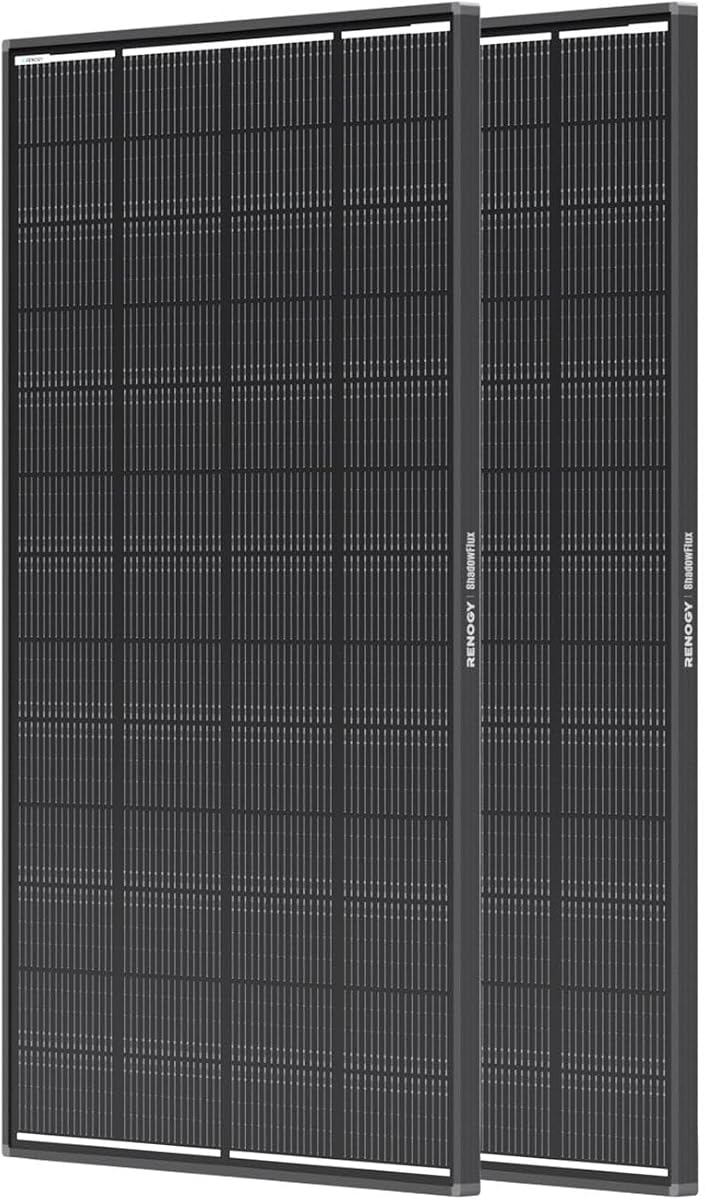
The Renogy 400W ShadowFlux delivers serious power for boats with high energy demands. It combines two 200W panels into a single unit, offering robust output suitable for running multiple appliances or charging large battery banks.
We may earn a commission when you buy through this link, at no additional cost to you.
Its ShadowFlux technology ensures that if one section is shaded, the other continues to produce power. This reliability is crucial for long-term cruising where weather patterns and mast shadows can vary unpredictably during the day.
Despite its high output, the design remains compact relative to its wattage. The IP67 rating and durable materials ensure it can withstand salt spray, wind, and debris without degradation over years of use.
Boaters seeking a premium, high-capacity solar solution will find this panel exceptional. It is an investment in energy independence, providing a strong foundation for off-grid living on the water.
400W output supports heavy loads and rapid battery charging for extended stays.
Dual module design ensures power stability even when environmental conditions change.
We may earn a commission when you buy through this link, at no additional cost to you.
The SUNER POWER 50W PRO offers a solid middle ground between small trickle chargers and large arrays. With 50 watts, it can handle more substantial charging needs than a 20W unit without requiring a massive installation footprint.
We may earn a commission when you buy through this link, at no additional cost to you.
Its Ultra-Smart MPPT controller significantly boosts efficiency, making better use of available sunlight. The visual indicators allow you to monitor battery status precisely, ensuring your system is performing optimally at all times.
Users can select specific modes for Lithium or AGM batteries, optimizing the charge profile for safety and longevity. This versatility makes it suitable for a wide range of modern vessel electrical systems and battery types.
For small boats needing more than a trickle charger but less than a full array, this kit is ideal. It simplifies the setup process by including advanced controller features in a single package.
MPPT technology converts more sunlight into usable charge for your specific battery type.
Multiple protections prevent overcharging and overheating to extend battery lifespan.
We may earn a commission when you buy through this link, at no additional cost to you.
The POWOXI 7.5W is an entry-level charger designed primarily for small applications like motorcycles or auxiliary batteries. It provides a basic way to offset self-discharge without complex wiring or installation steps.
We may earn a commission when you buy through this link, at no additional cost to you.
The LED indicator offers immediate feedback on whether the panel is receiving sun and charging the battery. Its ABS+PC frame is more durable than flexible alternatives, though it is heavier and less adaptable to curved surfaces.
While the wattage is low for powering boat systems, it is sufficient for maintaining a battery in storage. It is a straightforward solution for preventing dead batteries during long periods of inactivity.
For boaters with minimal power needs or those on a tight budget, this unit offers basic functionality. However, for active marine use, higher wattage options will provide more reliable and useful power.
Designed to offset natural battery discharge during storage with minimal effort.
LED light confirms that the unit is active and charging correctly.
We may earn a commission when you buy through this link, at no additional cost to you.
Selecting the right marine solar panel depends on your vessel size, power needs, and budget. This guide covers essential factors to consider before making a purchase.
Calculate your daily energy consumption in watt-hours to determine the necessary panel size. This ensures your system can meet your load demands during days with limited sunlight.
Aim for a panel capacity that exceeds your daily usage by at least 20 percent to account for inefficiencies and cloudy weather.
Higher efficiency panels generate more power per square foot, which is crucial for limited roof space on boats. N-type and bifacial technologies offer superior performance compared to older PERC models.
Prioritize panels with high conversion rates to maximize energy output from your available surface area.
Marine environments are harsh, exposing equipment to salt spray, high humidity, and UV radiation. Look for panels with anodized aluminum frames, tempered glass, and IP67 or higher ratings.
Choose rigid or flexible panels based on your hull shape but ensure the build quality can withstand long-term exposure to the elements.
Boats often have masts or rigging that cast shadows on solar panels. Shading can severely reduce output, so technology like anti-shading or bypass diodes is valuable.
Select panels designed to handle partial shading to ensure consistent power even when the sun angle changes.
A good charge controller prevents battery damage by regulating voltage and current. MPPT controllers are more efficient than PWM models, especially for larger arrays.
Ensure your chosen panel matches the input voltage and current limits of your existing or planned controller.
The mounting method affects both aesthetics and energy capture. Rigid mounts are easier but add drag, while flexible mounts sit flush but may degrade faster.
Consider adjustable brackets to optimize the angle for your specific location and seasons.
Solar panels are a long-term investment, so check the warranty terms for both power output and materials. Reputable brands often offer 25-year performance guarantees.
Choose manufacturers with strong customer support to assist with any technical issues or claims.
Regularly clean your panels with fresh water and a soft cloth to remove salt, dirt, and bird droppings that reduce efficiency. Avoid harsh chemicals that could damage the protective coating.
Check all connections and wiring periodically for signs of corrosion or wear. Use marine-grade connectors and secure cables to prevent them from chafing against the boat structure.
Ensure your charge controller settings match your battery type to prevent overcharging. Monitor the system output regularly to detect any drops in performance that might indicate a problem.
Rigid panels are generally more durable and efficient for long-term use on flat surfaces. Flexible panels are better for curved decks where rigids cannot mount, but they may have a shorter lifespan.
The number depends on your energy usage. A small boat with minimal electronics may need only 100W, while a liveaboard may require 400W or more to run appliances off-grid.
Yes, a charge controller is essential to regulate voltage and protect your batteries from overcharging. It ensures safe and efficient charging for all battery types used in marine applications.
Solar panels still generate power in cloudy conditions but at reduced efficiency. High-quality panels with anti-shading technology can capture diffuse light better to maintain some power output.
Use flexible panels designed to bend or use rigid panels on a custom flat frame. Secure them with marine-grade adhesives or screws to prevent wind lift while maintaining a clean look.
Clean the surface regularly to remove salt and dirt. Inspect wiring for corrosion and check controller settings annually to ensure optimal performance and safety for your batteries.
The Callsun 200W Bifacial and Renogy 400W ShadowFlux lead the pack with advanced efficiency and reliability features that ensure strong power generation.
Consider your specific power needs and deck space when choosing between rigid, flexible, or kits to find the perfect match for your vessel.
Verify current availability and pricing before purchasing to ensure you get the best deal for your marine solar upgrade this season.