
Pinhaijing LAN Ethernet 2 Way Relay Board
4.8Editor score
Simple TCP/UDP controller module
Cost-effective for basic needs
STC microcontroller for reliability
This guide compares the top Ethernet Relay Module options for industrial control and automation, featuring Modbus protocols and PoE support for reliable
Ethernet relay modules bridge the gap between network infrastructure and physical control systems. They allow you to switch high-voltage devices remotely using standard internet protocols. A good module offers stable connectivity, strong isolation, and flexible power options like PoE.
We evaluated ten top-rated models based on communication protocols, channel count, and build quality. Our analysis focuses on industrial durability, ease of integration with existing systems, and safety features that protect against electrical interference and voltage spikes during operation.
Each pick highlights specific strengths such as Modbus support, wireless capabilities, or rail-mount design. Prices and availability fluctuate frequently, so verify current listings before purchasing. This list helps you choose the right device for your specific automation or smart infrastructure project needs.
4.8Editor score

4.8Editor score

4.9Editor score
The following table provides a side-by-side comparison of the top ten Ethernet relay modules available on the market. It highlights key specifications including channel count, protocol support, and power options to help you quickly identify the model that fits your technical requirements.


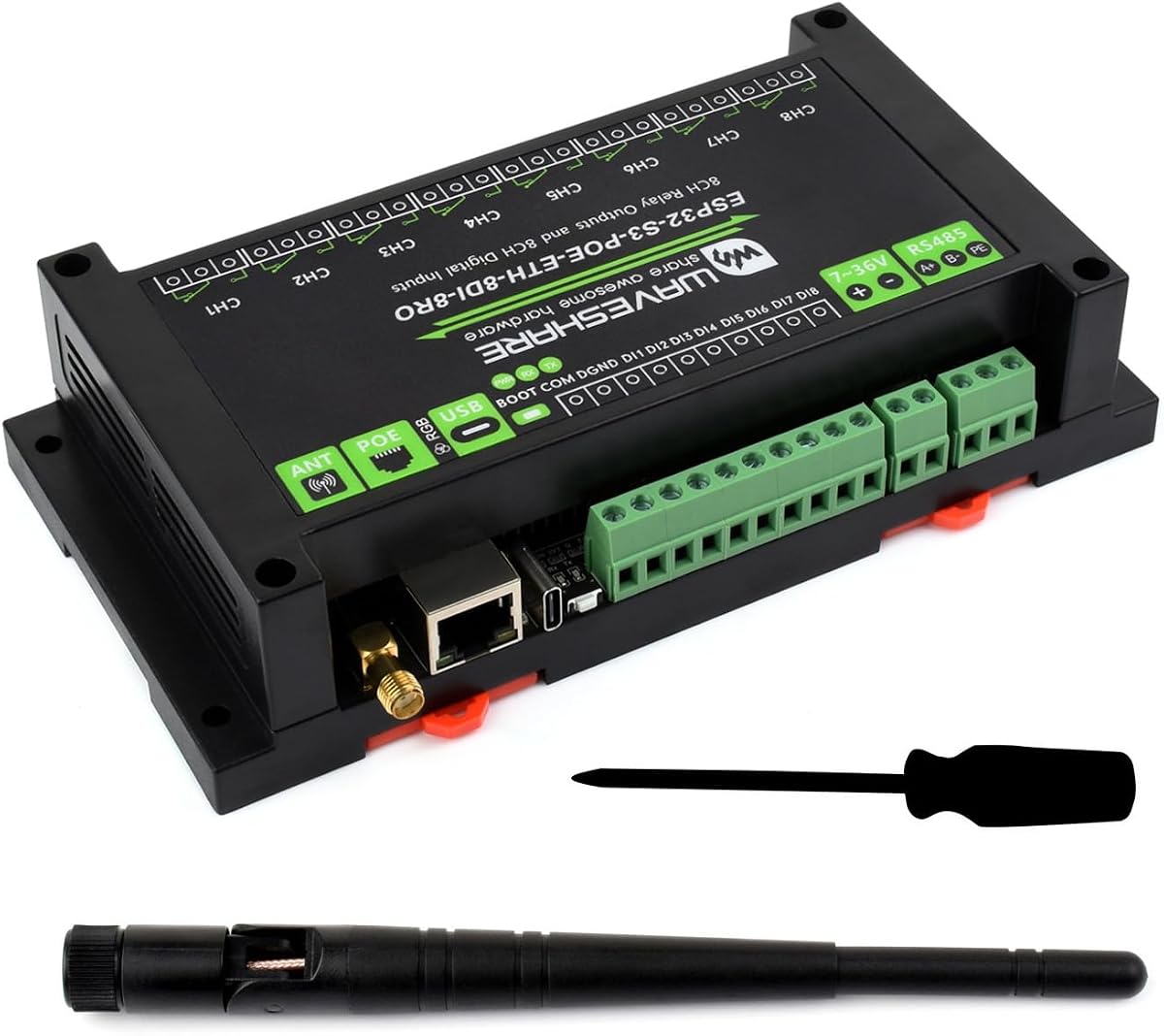
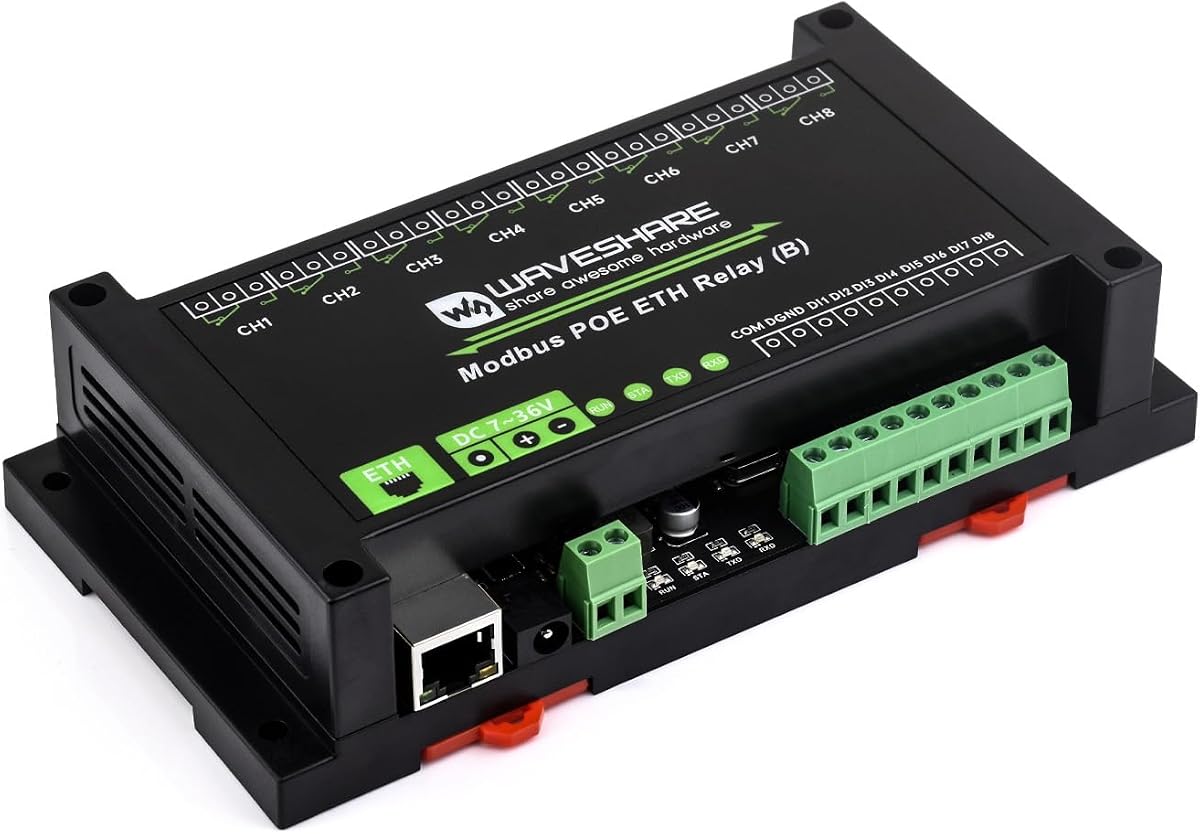

This Industrial 8-Ch ESP32-S3 WiFi Relay Module stands out as a top-tier choice for modern automation projects. It holds an impressive 4.8 rating from users who appreciate its robust design and versatile connectivity options.
We may earn a commission when you buy through this link, at no additional cost to you.
The device features a powerful ESP32-S3 microcontroller with a dual-core processor running up to 240MHz. It integrates both 2.4GHz Wi-Fi and Bluetooth LE for seamless remote control. Onboard interfaces include RS485, Ethernet, and digital inputs which allow flexible integration into complex industrial systems. The built-in PoE module simplifies installation by delivering power and data through a single cable.
While it offers exceptional performance, the unit does require some technical knowledge to configure fully. The wide range of features might be overwhelming for simple hobbyist projects where a basic module suffices. However, the reliability and safety features justify the investment for professional applications.
Experts should buy this module for smart home or industrial control setups that demand reliable wireless and wired connectivity. Its ability to handle 220VAC appliances safely makes it a versatile tool for managing high-power devices remotely with precision and control.
Supports RS485 and Bluetooth/WiFi remote control for versatile system integration.
Built-in multiple isolation protection circuits ensure safe operation with high voltage.
We may earn a commission when you buy through this link, at no additional cost to you.
The Pinhaijing LAN Ethernet 2 Way Relay Board is an excellent entry-level option for those needing basic network control. It carries a strong 4.8 rating from users who value its simplicity and cost-effectiveness for smaller applications.
We may earn a commission when you buy through this link, at no additional cost to you.
This board utilizes a sturdy STC microcontroller designed for industrial master chip reliability. It supports standard TCP and UDP protocols allowing you to control relays via local networks easily. The module functions as a web server so you can manage states directly from a browser. Its PCB is constructed from military grade FR-4 sheet material ensuring durability and stability under normal operating conditions.
The primary limitation is its restricted channel count which limits scaling potential for larger systems. It lacks advanced protocols like Modbus or wireless options found in more expensive units. Despite this, it remains a reliable choice for focused tasks requiring minimal switching points.
Buy this module if you need a simple, low-cost solution for turning specific devices on and off over a network. It is ideal for basic home automation or small office setups where extensive channel capacity is not a primary requirement for success.
Offers a low price point while maintaining reliable TCP/UDP controller functionality.
Constructed with 1.6mm thick PCB and military grade FR-4 sheet material.
We may earn a commission when you buy through this link, at no additional cost to you.
The 8-CH Ethernet Relay Module (B) with Digital Input leads the category with a nearly perfect 4.9 rating. It is engineered for industrial environments where reliability and protocol compliance are non-negotiable for consistent operation.
We may earn a commission when you buy through this link, at no additional cost to you.
This model adopts Modbus RTU and Modbus TCP protocols which are standards in industrial automation. It includes 8-ch digital inputs with bi-directional optocoupler isolation to protect the controller from high-voltage interference. Configuration is flexible via software or web browser with dynamic IP support through DHCP. The device supports multiple power options including PoE compliant with IEEE 802.3af standards for simplified cabling.
While highly capable, the range of configuration methods may require time to master effectively. The price point reflects its premium industrial grade construction which might exceed budgets for simple projects. However, the stability and protection features offer peace of mind for critical applications.
Invest in this module for professional systems requiring precise protocol control and safety isolation. It is particularly suited for factory automation or smart infrastructure where monitoring inputs and controlling outputs over Ethernet must be highly reliable and safe.
Adopts Modbus RTU and Modbus TCP for reliable industrial communication standards.
Supports DC 7~36V input and PoE compliant IEEE 802.3af power supply.
We may earn a commission when you buy through this link, at no additional cost to you.
The 8-CH Ethernet Relay Module offers a straightforward approach to industrial network switching. While it holds a 3.4 rating, it provides essential features like Modbus support and PoE power for compatible network setups efficiently.
We may earn a commission when you buy through this link, at no additional cost to you.
This module allows control via Ethernet port using Modbus RTU or TCP protocols. It supports DC 7~36V power input and offers PoE for single-cable deployment. Features include flash-on and flash-off functions that can turn a relay on temporarily via command. Onboard optocoupler isolation helps prevent interference from high-voltage circuits during operation.
The rating suggests some users encountered connectivity issues or difficulties with the provided documentation. It may lack the polish of higher-end models like Waveshare. Yet it remains a viable option for systems requiring basic Modbus communication at a competitive price point.
Consider this module for applications where standard Modbus protocols are necessary without extra features. It fits well in setups needing simple Ethernet control and rail mounting where budget constraints are a significant factor in procurement decisions.
Adopts Modbus RTU and Modbus TCP for easy industrial network integration.
Supports flash-on and flash-off functions via command passing for timed use.
We may earn a commission when you buy through this link, at no additional cost to you.
The Waveshare 8-Ch Ethernet Relay Module delivers solid performance for general industrial needs. With a 4.1 rating, it is known for its sturdy ABS rail-mount case and comprehensive isolation circuits that protect connected devices effectively.
We may earn a commission when you buy through this link, at no additional cost to you.
This module uses Modbus RTU and TCP protocols for control via Ethernet. It supports PoE power supply for simplified wiring in networked environments. The design includes reverse-proof circuit to prevent damage from incorrect connections. Network indicators help monitor MCU status and signal transceiving status visually.
Users note that initial configuration requires attention to detail which might slow down deployment. It lacks advanced wireless options found in newer models. Nevertheless, its physical protection and stability make it a dependable choice for fixed installations.
Choose this module when physical robustness and standard Modbus support are priority requirements. It is well-suited for machine control panels or industrial cabinets where rail mounting and isolation are essential for safety.
Comes with a durable industrial grade ABS rail-mount case for safety.
Features 4 LEDs and network indicators to track device status clearly.
We may earn a commission when you buy through this link, at no additional cost to you.
This Industrial 8-Ch ESP32-S3 WiFi Relay Module offers a powerful alternative with extensive connectivity features. It holds a 4.6 rating from users who value the dual-core processor and extensive software support for custom development.
We may earn a commission when you buy through this link, at no additional cost to you.
The board integrates an ESP32-S3 microcontroller with a 32-bit LX7 dual-core processor running up to 240MHz. It includes Wi-Fi and Bluetooth LE for versatile wireless control. Onboard interfaces include RS485 and Ethernet alongside digital inputs. It supports the Arduino IDE with a comprehensive SDK and online technical resources.
While highly capable, it may require external power since it does not always include PoE in all variations. The feature set is rich which means setup is more involved than simpler boards. But this flexibility makes it ideal for complex custom applications.
Developers should buy this module for projects requiring both wireless and wired industrial protocols. It is excellent for prototypes or production systems needing robust local processing and remote access via multiple channels simultaneously.
Comprehensive SDK and Arduino IDE support with online development resources.
Integrated 2.4GHz Wi-Fi and Bluetooth LE dual-mode communication.
We may earn a commission when you buy through this link, at no additional cost to you.
The Waveshare 30-Ch Ethernet Relay Module stands out for its massive channel count in a compact industrial design. With a 4.2 rating, it is selected by users needing to manage dozens of devices from a single network interface point.
We may earn a commission when you buy through this link, at no additional cost to you.
This module handles 30 relay channels controlled via Ethernet port using Modbus RTU or TCP protocols. It supports PoE power supply and features onboard optocoupler isolation. The dedicated relay driver chip includes built-in flyback diode protection for stable driving ability. Network indicators help track the device status effectively.
The size and number of channels mean it requires more space and power than smaller models. It is not suitable for simple tasks but excels in large scale systems. The industrial design ensures durability in demanding environments.
Use this module for large industrial control setups or agriculture systems where many circuits must be managed. It fits well in breeding farming or facility management scenarios requiring high density switching capabilities.
Provides 30 relay channels for managing large scale systems efficiently.
Adopts dedicated relay driver chip with flyback diode protection for stability.
We may earn a commission when you buy through this link, at no additional cost to you.
The Waveshare 8-Channel ESP32-S3 WiFi Relay Module combines high performance with industrial connectivity. It has a 4.7 rating from users who rely on its Xtensa processor and isolated RS485 interface for robust system control.
We may earn a commission when you buy through this link, at no additional cost to you.
Based on the ESP32-S3 microcontroller it runs at up to 240 MHz. It includes integrated 2.4GHz Wi-Fi and Bluetooth LE dual-mode communication. The onboard isolated RS485 interface supports Modbus industrial modules. It features a dedicated RTC chip for scheduled tasks and indicators for monitoring device status.
One note is that the PoE Ethernet Port is available only in optional versions which requires checking the specific model before buying. The setup process can be technical but the wiki resources help. The build quality is generally high for industrial use.
Buy this module for applications needing precise scheduling and isolated serial communication. It suits developers and engineers working on projects that require both wireless flexibility and industrial protocol standards.
Built-in RTC chip allows for automated scheduled tasks without external timers.
Onboard isolated RS485 interface connects to various Modbus industrial modules.
We may earn a commission when you buy through this link, at no additional cost to you.
The Waveshare 8-Ch Ethernet Relay Module (B) offers detailed logic features for advanced automation. With a 4.2 rating, it is appreciated by users who need smart linkage control and active digital input handling for safety.
We may earn a commission when you buy through this link, at no additional cost to you.
This module supports flash-on and flash-off functions via command arguments. It includes active and passive digital input with bi-directional optocoupler isolation. A built-in debouncing algorithm improves signal reliability. The relay supports digital input linkage control or toggle control for smart automation without external logic.
It is very similar to other models in the list but includes extra digital input features which adds value. The price is slightly higher due to these extras. Setup requires careful configuration to leverage the logic features properly.
Select this module when smart local logic and input monitoring are required. It fits well in security systems or interlock applications where physical inputs must trigger relays automatically and safely.
Supports relay digital input linkage control for automated responses.
Built-in debouncing algorithm ensures stable digital input readings.
We may earn a commission when you buy through this link, at no additional cost to you.
This 8-CH Ethernet Relay Module provides a reliable foundation for industrial networking. It holds a 4.0 rating and is selected for its support of multiple communication modes including HTTP and MQTT which are popular in modern IoT systems.
We may earn a commission when you buy through this link, at no additional cost to you.
The module supports Modbus RTU and Modbus TCP protocol commands sent via Ethernet port. It offers software and Web Browser Configuration with dynamic IP support via DHCP. It supports PoE compliant with IEEE 802.3af and includes onboard optocoupler isolation. It also includes flash-on flash-off functions for temporary switching tasks.
While it offers a solid feature set it lacks the wireless flexibility of ESP32 models. Users should note that configuration might require some networking knowledge. However the variety of supported protocols makes it adaptable to many systems.
Use this module for systems where HTTP or MQTT integration is needed alongside Modbus. It is suitable for general industrial control where stability and protocol versatility are more important than wireless capabilities.
Supports HTTP and MQTT protocols for integration with IoT platforms.
Obtains Dynamic IP via DHCP and supports DNS for domain name connection.
We may earn a commission when you buy through this link, at no additional cost to you.
Selecting the right Ethernet relay module requires careful evaluation of your network and power requirements. This guide breaks down the critical factors to ensure compatibility with your existing infrastructure and long-term reliability in your specific application environment.
The communication protocol determines how your module interacts with your network. Modbus RTU and Modbus TCP are industrial standards widely used in automation systems for reliability and interoperability. If you need web integration or IoT cloud features, check for HTTP, MQTT, or UDP support. Always verify that your existing controllers and software can communicate using the same protocols supported by the module.
Prioritize modules that support both Modbus TCP and HTTP if your network uses mixed legacy and modern systems. This ensures you can switch control methods without replacing hardware in the future.
Power delivery flexibility is crucial for clean installation. Look for modules that support PoE (Power over Ethernet) as it simplifies wiring by providing both data and power through a single cable. Some units also offer wide DC voltage ranges like 7~36V to work with various industrial power supplies. Ensure the power requirements match your site availability.
Choose PoE compliant models to reduce cable clutter and installation costs. If PoE is not available, verify the unit accepts a DC input range that matches your local power source to avoid needing extra adapters.
Channel count defines how many devices you can control simultaneously. While 8-channel units are standard for small to medium projects, larger setups like farms or factories may need 30-channel models. Consider future growth and plan for enough channels to avoid adding more modules later which increases network complexity.
Select a channel count that covers your current needs plus a buffer for expansion. If you plan to scale, choose a module that supports daisy-chaining or network addressing to manage multiple units easily.
Input types define what sensors you can connect. Support for passive dry contacts and active wet contacts allows flexibility in connecting various sensors and switches. Output ratings determine the load capacity; ensure the contact rating like 10A 250VAC matches the devices you intend to switch.
Always check the voltage and current ratings of the relays against your appliances. Using relays beyond their rating can cause failure or safety hazards. Ensure input isolation is present to protect your network controller from noise.
Isolation protects your low-voltage network from high-voltage spikes. Optocoupler isolation separates the control circuit from the relay circuit. This prevents electrical interference and reduces the risk of damaging your controller or computer. Look for reverse-proof circuits that protect against accidental wrong wiring.
Prioritize modules with onboard optocoupler isolation for safe operation. This feature is essential when switching high-voltage appliances like heaters or motors in industrial or commercial environments.
Physical form factor matters for professional installations. Industrial grade rail-mount cases allow you to secure the module in a standard control panel. A durable ABS enclosure protects against dust and minor impacts. Compact designs help in tight spaces while still offering all features.
Choose a rail-mount module for fixed installations to ensure safety and organization. Verify the dimensions fit your enclosure or panel space before purchasing.
Wireless support adds flexibility if running Ethernet cables is difficult. Modules with Wi-Fi and Bluetooth LE allow remote access without additional wiring. However, wired Ethernet remains more stable for critical industrial tasks. Ensure the wireless module also offers an Ethernet port for primary reliability.
Opt for models with both Ethernet and wireless options. This hybrid approach gives you the reliability of wired networks with the flexibility of remote control when needed.
Ease of setup impacts project timelines. Look for modules offering web browser configuration or dedicated software tools. Support for dynamic IP via DHCP simplifies network integration without manual addressing. Clear status indicators and LED lights help troubleshoot issues quickly.
Select a module with web browser access for quick configuration. This allows you to manage settings directly from a browser without needing specialized software or drivers installed.
Begin by connecting the module to your local network using an Ethernet cable or Wi-Fi depending on the model capabilities. Ensure the power supply matches the unit requirements either via DC input or PoE. Access the web interface or configure software to set the IP address and communication protocols for your controller.
Program the relays by defining logic rules such as automatic switching based on digital inputs or timers. Use the provided SDK or web tools to send commands. Always test the connections with low voltage or a small load to confirm functionality before connecting high-power devices.
Maintain the module by keeping it in a dry, cool environment free of dust. Check status LEDs periodically to ensure healthy network signals. Keep firmware updated through the manufacturer portal to fix bugs and improve security. If the unit stops responding, power cycle it and verify network cable connections first.
Yes, many Ethernet relay modules support HTTP, MQTT, or web interfaces that integrate with smart home platforms like Home Assistant. However you may need to set up specific plugins or scripts since most do not come with native support for consumer ecosystems like Alexa. Check compatibility documentation before purchasing.
No, only modules explicitly stating PoE support can draw power through the Ethernet cable. Most industrial units include IEEE 802.3af compliance but you must verify the label. If not supported, you must use a separate DC power supply and a standard Ethernet cable for data.
Modbus RTU uses serial communication typically over RS485 wires while Modbus TCP runs over Ethernet. TCP is faster and easier to integrate into IP networks but RTU is still common in legacy industrial setups. Some modules support both so you can use either depending on your existing hardware.
To protect the module use a surge protector on the power input and ensure the Ethernet port has isolation. Many industrial units have onboard protection circuits but adding an external UPS for power and an Ethernet surge protector adds extra safety especially in outdoor or heavy industrial environments.
Most modules are rated for 250VAC up to 10A which is sufficient for standard home appliances like heaters or lights. Always check the specific contact rating on the product. Ensure you use proper wiring and enclosures to avoid fire or shock hazards when switching mains voltage.
Many modules allow control via web browser or standard network tools. For advanced logic you might use Python or a dedicated SCADA system. Most vendors provide SDKs or APIs so you can build custom interfaces. Basic testing can be done with simple network scripts or terminal commands.
Local control remains available if the module is on your local network even if external internet fails. You can still access the web interface via local IP. Some modules support local automation rules so scheduled tasks or sensor triggers continue working without needing cloud access.
It depends on the channel count. Standard units have 8 channels allowing control of 8 independent circuits. Larger models offer up to 30 channels. You can cascade multiple units if you need more control points but each will require its own IP address on the network.
We have reviewed ten top Ethernet relay modules ranging from simple cost-effective boards to advanced industrial controllers. The Industrial 8-Ch ESP32-S3 WiFi Relay Module stands out as our top choice for its wireless flexibility and performance. The Pinhaijing LAN Ethernet Board offers a budget-friendly entry for basic tasks.
When prioritizing your choice focus on protocol support and power options like PoE to ensure long-term stability. Safety features such as optocoupler isolation are non-negotiable for handling high voltage. Choose a module that fits your specific need whether it is industrial automation or home control.
Prices and availability change frequently so always check current listings before purchasing. Verify the specific model features match your project requirements. With the right selection you can build a reliable networked control system that meets your technical needs efficiently.