
Battery Equalizer 48V
4.3Editor score
Flexible multi unit parallel usage
5A compensation current trigger
Smart indicator lights for status
This guide compares the top 10 12V 24V 48V Battery Equilizer Balancer models for active balancing safety protection and compatibility with diverse battery
Finding the right battery management system is crucial for anyone running a 12V 24V or 48V battery bank. A quality equalizer ensures cells stay matched which prevents premature failure and maximizes usable energy output.
We evaluated ten leading balancers based on balancing current, voltage tolerance, safety features, and supported battery chemistries. Our analysis includes real world application notes and technical specifications to help you choose wisely.
Each pick below highlights specific strengths like active mode or standby efficiency. Note that retail pricing fluctuates frequently so verify current costs before purchasing your next battery protection device.
4.3Editor score

4.3Editor score

4.1Editor score
The table below provides a side by side overview of all ten selected battery equalizers. Compare their voltage ranges, balancing currents, and key protections at a glance.



The LiTime 48V Battery Balancer leads our list with its robust active balancing technology designed for 24V to 48V systems. It earns a strong 4.3 user rating by delivering consistent voltage matching across diverse battery chemistries.
We may earn a commission when you buy through this link, at no additional cost to you.
Its standout quality is the 10A maximum working current which actively equalizes voltage differences up to 10mV before switching to a standby mode drawing less than 5mA. This ensures your battery bank stays healthy without wasting power overnight.
The main trade-off is the need for precise wiring when connecting to parallel series configurations which can be tricky for beginners. However the reverse polarity and high temperature protections mitigate these risks effectively.
Buyers building a 48V bank with 12V batteries will find this the most reliable companion. Its insurance coverage and broad chemical compatibility make it a top recommendation for serious energy storage projects.
The device automatically starts balancing when voltage differences exceed 10mV ensuring cells stay matched during charge cycles.
It works with LiFePO4 Lithium ion lead acid GEL and SLA batteries rated between 3V and 20V.
We may earn a commission when you buy through this link, at no additional cost to you.
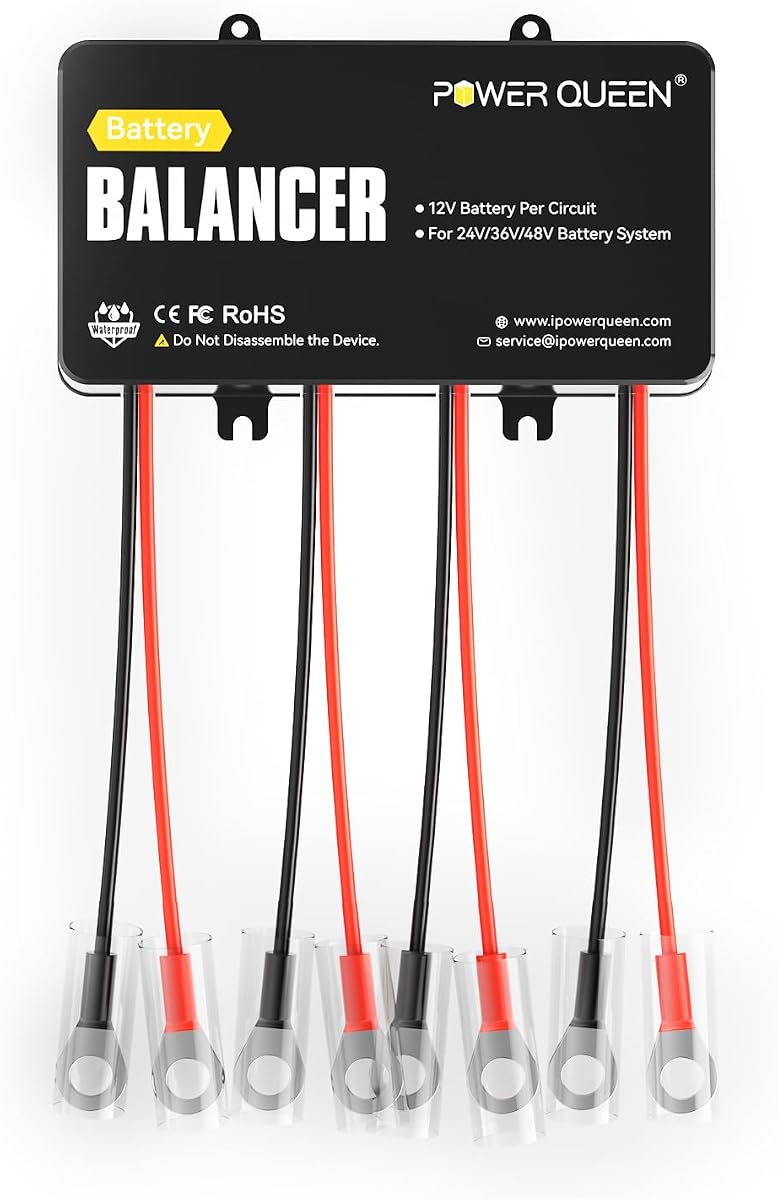
The Power Queen Battery Balancer 48V offers excellent value with active balancing capabilities similar to more expensive models. It maintains a 4.3 rating for its ability to extend battery life efficiently in RV solar and off grid systems.
We may earn a commission when you buy through this link, at no additional cost to you.
Its key strength is the intelligent auto balancing feature that activates when differences exceed 10mV and switches to low power standby once balanced. This saves energy while protecting your investment over the long term.
While the manual is concise the reverse polarity and high temperature safeguards provide peace of mind against common installation errors. Users must ensure they connect parallel first then series to avoid issues.
This balancer is ideal for budget conscious users seeking reliable active balancing without sacrificing safety features. It supports all common battery types making it a versatile choice for diverse energy needs.
Once voltage differences drop below 10mV the unit draws only 5mA keeping your battery bank ready for use.
It handles LiFePO4 lead acid and SLA batteries within the 3V to 20V range effectively.
We may earn a commission when you buy through this link, at no additional cost to you.
The Victron Energy Battery Balancer is a trusted choice for series connected 12V battery banks. It carries a 4.2 rating and is known for improving battery life by eliminating load imbalance effects effectively.
We may earn a commission when you buy through this link, at no additional cost to you.
Its strength lies in its simplicity and reliability. It draws up to 1A from the highest voltage battery to equalize the state of charge. For 48V systems you can parallel three units to cover the full bank.
The trade-off is the lower 1A current which balances more slowly than competitors offering 10A. However for steady state maintenance this is sufficient and reduces heat generation significantly.
Buyers prioritizing brand reputation and simple expansion options should choose this model. It is particularly well suited for marine and off grid applications where stability is paramount.
You can parallel multiple balancers to handle higher voltages like 48V without complex wiring changes.
The unit activates when system charge voltage exceeds 27V ensuring balancing happens when it is needed most.
We may earn a commission when you buy through this link, at no additional cost to you.
The Battery Equalizer Voltage Balancer stands out for its wide voltage range supporting systems up to 96V. It holds a 4.5 rating for its effectiveness in diverse applications like golf carts electric forklifts and solar systems.
We may earn a commission when you buy through this link, at no additional cost to you.
Its main feature is the rail type buckle installation which makes mounting inside a distribution box straightforward. It supports batteries from 7V to 18V and allows any number of batteries to connect in series or parallel.
While specific balancing current data is less explicit than other models its broad compatibility with nickel cadmium and nickel hydrogen batteries is unique. This makes it a versatile tool for older or specialized battery configurations.
Buyers needing a robust solution for high voltage or mixed chemical systems will appreciate this model. Its high rating suggests strong performance in real world demanding scenarios.
The rail type buckle design allows for easy module installation in standard distribution boxes.
It supports battery banks from 12V up to 96V covering almost every common industrial application.
We may earn a commission when you buy through this link, at no additional cost to you.
This 48V Battery Voltage Balancer includes an LED display to visually monitor battery voltages without extra tools. Despite a lower 3.7 rating it offers practical protection features for standard 48V battery banks.
We may earn a commission when you buy through this link, at no additional cost to you.
Its key feature is the visible LED display which provides immediate feedback on the health of your connected batteries. It also includes reverse polarity and low voltage disconnect to maintain battery health and extend service life.
The main trade-off is the lower rating which may indicate reliability or installation challenges for some users. However the low voltage disconnect feature adds value for those worried about over discharging.
Buyers who prefer visual feedback on their battery system will find this useful. Ensure you check installation instructions carefully if you plan to extend to 96V with multiple units.
The LED display allows users to check battery status without needing a separate multimeter.
Built in reverse polarity and low voltage disconnect help prevent common damage scenarios.
We may earn a commission when you buy through this link, at no additional cost to you.
The Redodo Battery Balancer 24V is an excellent choice for 24V systems. It features a 10A maximum equalization current which ensures rapid balancing when needed. Its 4.4 rating reflects high user satisfaction.
We may earn a commission when you buy through this link, at no additional cost to you.
Key features include an LED display and M8 OT terminals for secure connections. The dual automatic protection functions cover reverse connection and high temperature risks ensuring safe long term use.
While designed primarily for 24V (2x12V) setups the wide voltage range allows flexibility. The main trade-off is the focus on smaller systems compared to units supporting 48V directly.
Buyers with marine or RV applications needing fast balancing will love this model. Its warranty and technical support add value for those wanting reliable service.
A 10A maximum equalization current ensures quick voltage matching between batteries.
Included M8 OT terminals simplify the connection process to battery posts.
We may earn a commission when you buy through this link, at no additional cost to you.
This Power Queen Battery Equalizer 48V mirrors the capabilities of its sibling model. It supports 24V to 48V systems with active balancing technology that maintains battery health efficiently. It holds a 4.1 user rating.
We may earn a commission when you buy through this link, at no additional cost to you.
Its key feature is the intelligent auto balancing that activates above 10mV difference. Once balanced it switches to standby mode drawing only 5mA which preserves your battery energy for actual loads.
The trade-off is limited specific documentation compared to other brands which can make installation slightly more challenging. However the reverse polarity and temperature protections are robust.
Buyers looking for proven active balancing for RVs and solar systems should consider this. Its compatibility with LiFePO4 and lead acid makes it versatile for various energy needs.
Low power standby mode ensures energy is not wasted on the balancer when batteries are balanced.
Reverse polarity and high temperature safeguards protect the unit from common electrical errors.
We may earn a commission when you buy through this link, at no additional cost to you.
This Battery Equalizer 48V offers a cost effective solution for balancing 24V to 48V systems. It supports flexible multi unit parallel usage which allows scaling to higher voltage banks easily. It maintains a 4.3 rating.
We may earn a commission when you buy through this link, at no additional cost to you.
The key feature is its low 5A compensation current and smart indicator lights that show status clearly. It activates automatically when voltage discrepancies surpass 10mV ensuring balanced cells without manual intervention.
The main trade-off is the lower current which means slower balancing compared to 10A models. However for steady maintenance this is sufficient and reduces heat generation significantly.
Buyers looking for an economical option with clear status feedback will appreciate this model. Its compatibility with a wide range of chemistries makes it useful for diverse battery setups.
Indicator lights provide immediate visibility of the balancer status and operational state.
Built in low voltage cutoff prevents battery discharge that could damage sensitive electronics.
We may earn a commission when you buy through this link, at no additional cost to you.
The HA01 Battery Equalizer offers a digital LED display to monitor battery voltages. It supports N x 12V systems and balances with 5A compensation current. It holds a 4.3 rating among users.
We may earn a commission when you buy through this link, at no additional cost to you.
Its strength is the digital display and flame retardant shell which aids safety and visibility. It balances with low power consumption and reverse polarity protection ensuring safe long term operation.
The main trade-off is the 5A current limit which is lower than the 10A units. However for standard maintenance this is sufficient and the digital readout adds valuable convenience.
Buyers who prefer digital displays for quick checks will find this useful. Its compatibility with 24V to 48V systems makes it a practical choice for solar and RV setups.
The LED digital display makes it easy to check voltage without additional tools.
The shell is made of flame retardant material for safer installation in tight spaces.
We may earn a commission when you buy through this link, at no additional cost to you.
The MAZAVA Battery Equalizer HX02 offers a premium LCD monitor for detailed voltage tracking. It supports active balancing for 12V to 48V systems. It holds a 4.1 rating for its performance.
We may earn a commission when you buy through this link, at no additional cost to you.
Key features include an aluminum alloy shell for better heat dissipation and multi module parallel support. It detects voltage differences in thousandths ensuring fast and precise equalization.
The main trade-off is the higher price and potential complexity in setup compared to simpler models. However the monitor adds significant value for those needing precise data.
Buyers who need detailed monitoring for critical battery systems will find this model ideal. Its heat dissipation and multi module support make it suitable for demanding industrial applications.
The LCD monitor provides detailed voltage data for critical battery tracking.
Aluminum alloy shells ensure the unit stays cool during extended operation.
We may earn a commission when you buy through this link, at no additional cost to you.
Choosing the right battery balancer depends on your bank voltage, chemistry, and desired balancing current. This guide outlines the key factors to ensure compatibility and safety.
Ensure the balancer supports your bank maximum voltage. Some units are limited to 24V while others support 48V or 96V. Check the product specs to match your setup.
Pick a model that explicitly supports your maximum bank voltage.
Active balancers draw current to equalize cells. Higher current like 10A balances faster but may draw more power. Smaller currents like 5A are gentler but slower.
Choose 10A for fast active balancing or 5A for low power standby maintenance.
Verify the balancer supports your battery type. Most support LiFePO4 and lead acid but some include NiCd or NiMH. Using the wrong balancer can damage sensitive chemistries.
Confirm the unit covers LiFePO4 lead acid or any specific chemistry you use.
Balancers draw small power continuously. Look for units with low standby draw like 5mA to prevent drain when not actively balancing. This is crucial for solar or off grid setups.
Prioritize models with less than 5mA standby draw for energy efficiency.
Consider the mounting style. Rail type buckle installation allows easy mounting in a distribution box. Others may require specific wiring steps for series parallel banks. Ensure you can install it safely.
Check the physical design matches your distribution box or enclosure.
Look for reverse polarity protection to prevent damage from accidental wiring. High temperature protection and low voltage disconnect are also vital for battery health. These features protect both the balancer and your bank.
Verify the unit includes reverse polarity and temperature safeguards.
Some units include LED or LCD displays for real time voltage monitoring. This helps troubleshoot issues quickly. Others rely on external multimeters for status checks. Consider your comfort level with tools.
Choose a model with a display if you prefer visual status checks.
Check the warranty term and technical support availability. Brands offering 1 year warranties and responsive support are preferable for long term peace of mind. This ensures you get help if issues arise.
Select a vendor with clear warranty and support terms.
Connect the balancer in parallel with your battery strings ensuring correct polarity. Follow the series parallel wiring instructions carefully to avoid shorts or reverse connections.
Mount the unit securely in a cool dry place to prevent overheating. Use rail type buckles or standard screws as provided to ensure stable operation during travel or vibration.
Inspect the connections periodically to ensure no corrosion or loosening. Use your multimeter or display to monitor voltage differences and confirm the balancer is actively maintaining balance.
Active balancers move energy between cells to equalize voltage while passive balancers bleed off excess energy. Active balancing is more efficient and saves battery capacity making it better for large banks.
Yes most modern balancers support both LiFePO4 and lead acid chemistries. Always verify the voltage range and current limits match your specific battery requirements.
Yes it draws a small standby current like 5mA to monitor voltages. Choose low power models to minimize impact on your battery life especially in solar systems.
Connect the batteries in parallel groups first then in series. Use a balancer that supports 48V or combine multiple units to match your total bank voltage accurately.
The balancer will activate to reduce the difference up to its maximum current. If the difference is large it may take time to balance. Check your battery health if discrepancies persist.
Yes many models support parallel connections for 48V or 96V systems. Ensure the units are compatible and follow the manufacturer wiring guidelines for safe expansion.
High temperature alerts indicate overheating which can damage the unit or batteries. Ensure it is installed in a ventilated area and disconnect if the warning persists.
A display shows approximate voltages but a multimeter gives precise readings. Keep a multimeter handy for calibration and detailed troubleshooting during setup.
Our top picks include the LiTime 48V Battery Balancer for active performance and the Power Queen 48V for budget conscious users. Both offer strong safety and compatibility features.
Prioritize current and voltage range when making your selection. Ensure the unit matches your bank and chemistry to avoid compatibility issues over time.
Always verify current prices before purchasing as they fluctuate regularly. Choosing a model with strong warranties will protect your investment in the long run.