
SVBONY SV503 Telescope for Adults High Powered
4.8Editor score
102mm ED glass aperture
Dual-speed 1:10 focuser
90mm focus travel range
This expert guide compares the top apochromatic refractors for astronomy and astrophotography to help you choose the right optical performance and portability.
Apochromatic refractors are prized by astronomers for their sharp color correction and high contrast views. These telescopes use special glass to eliminate false color, making them ideal for planetary and deep-sky imaging. Choosing the right model depends on your budget, desired aperture, and whether you prioritize portability or optical resolution.
We analyzed ten top-rated apochromatic refractors based on optical design, build quality, and user feedback. Our comparison focuses on triplet and quadruplet configurations, focal ratios, and included accessories like field flatteners. Each entry highlights key strengths to help you match a telescope to your specific observing or imaging goals without confusion.
Every pick in this list showcases a distinct advantage, from budget-friendly ED glass to premium air-spaced triplets. We include detailed specs, pros, cons, and usage tips for each model. Note that availability and pricing fluctuate, so verify current details before purchasing to ensure you get the best value for your setup.
4.8Editor score

4.5Editor score

4.9Editor score
The following table provides a side-by-side comparison of all ten apochromatic refractors, highlighting their aperture, focal ratio, optical design, and key features to help you quickly identify the model that suits your astronomical needs.




The SVBONY SV550 AP0 stands out as a top contender in the apochromatic refractor category with its 80mm ED triplet design. It earns high marks for delivering sharp, high-contrast images while minimizing chromatic aberration effectively.
We may earn a commission when you buy through this link, at no additional cost to you.
Its air-spaced triplet optical structure uses S-FPL51 low-dispersion glass to correct blue-edge aberrations that plague simpler designs. The 2.5-inch magnesium alloy dual-speed focus mount ensures smooth adjustments and reduces weight compared to aluminum alternatives.
While it lacks included accessories like eyepieces, the internal extinction measures and optimized barrel design ensure crisp imaging across the field. This makes it a robust choice for serious observers prioritizing optical purity over package convenience.
Ideal for astrophotographers and visual observers seeking a balance between portability and performance, this OTA offers exceptional value. Its design supports full-frame cameras and provides the clarity needed for detailed deep-sky exploration.
The triplet apochromatic optics structure effectively eliminates blue-edge chromatic aberration for sharper star images.
Magnesium alloy construction reduces weight by over 20% while maintaining smooth dual-speed focusing action.
We may earn a commission when you buy through this link, at no additional cost to you.
The SVBONY SV503 offers a generous 102mm aperture at an accessible price point, making it a standout budget option. Its S-FPL51 ED glass delivers bright, high-contrast images with minimal color fringing for both visual and imaging use.
We may earn a commission when you buy through this link, at no additional cost to you.
Key features include a built-in 360-degree field rotator for easy camera alignment without tube rotation. The 90mm focus travel accommodates filters and flatteners, while the aluminum retractable hood blocks stray light and prevents dew.
While its larger aperture increases weight, the optical performance remains excellent for deep-sky photography. The FMC coating improves light transmission and reduces internal reflections, ensuring detailed views of faint nebulae and star clusters.
This telescope is perfect for adults seeking a powerful yet affordable refractor. Its versatile design supports planetary and deep-sky observation, offering superior optical quality without a premium price tag.
The 102mm aperture gathers more light than smaller scopes for clearer views of faint deep-sky objects.
The built-in 360-degree field rotator allows perfect camera framing without rotating the entire tube.
We may earn a commission when you buy through this link, at no additional cost to you.
The Askar 71F is a premium lightweight OTA designed for both visual observation and astrophotography. Its quadruplet air-spaced APO optics deliver exceptional correction while the integrated flat-field design simplifies imaging setup.
We may earn a commission when you buy through this link, at no additional cost to you.
Weighing only 2.5kg, this scope is ideal for travel and portable mounts. The CNC-processed barrel includes matte internal paint to reduce stray light reflections, enhancing contrast for detailed deep-sky imaging.
Despite its compact size, the 71mm aperture supports full-frame sensors with its large target surface. The rotating focus ring with adjustable screws ensures stable alignment during imaging sessions without needing additional rotators.
This telescope is best suited for astrophotographers prioritizing portability and optical quality. Its versatile design supports birding and scenery observation too, making it a true all-rounder for outdoor enthusiasts.
The integrated flat-field design eliminates the need for separate field flatteners, streamlining your imaging setup.
At just 2.5kg, this OTA is easy to transport and mount for spontaneous stargazing sessions anywhere.
We may earn a commission when you buy through this link, at no additional cost to you.
The Explore Scientific ED80 Essential Series uses genuine FCD1 HOYA ED glass to deliver brilliant, high-contrast views. Its proprietary enhanced multi-layer coatings on all optical surfaces ensure excellent transmission and minimal reflections.
We may earn a commission when you buy through this link, at no additional cost to you.
This telescope features a push-pull collimation system for precise adjustment of the front cell, guaranteeing tight star images. The retractable dew shield and 480mm focal length make it portable for spontaneous observing sessions.
While pricier than some competitors, the USA-based customer support and optical quality justify the investment. The f/6 focal ratio is versatile for both planetary and deep-sky targets like nebulae and clusters.
Ideal for astrophotographers who value precision and reliability, this scope allows separate guiding and imaging duties. Its air-spaced triplet design eliminates chromatic aberration, providing stunning details across the field.
FCD1 HOYA extra-low dispersion glass produces views filled with stunning details and excellent color correction.
Push-pull adjustments on the front cell allow you to achieve the tightest stars possible for imaging.
We may earn a commission when you buy through this link, at no additional cost to you.
This SVBONY SV550 bundle includes the SV209 field flattener designed to correct field curvature for deep-sky astrophotography. The 1.0X flattener ensures the astronomical conventional 55mm back focal length for compatibility.
We may earn a commission when you buy through this link, at no additional cost to you.
The package supports full-frame cameras with a 45mm large target surface and an M63 extension tube with M48 adapter ring. Internal extinction barriers and magnesium alloy construction reduce weight and improve contrast.
While it limits modularity by including specific accessories, the integrated setup ensures optimal performance out of the box. The hollow dovetail plate design allows easy operation and diverse accessory choices for mounting.
Perfect for astrophotographers seeking a ready-to-use kit, this bundle eliminates guesswork in field correction. Its design provides stability and clarity, making it a top choice for serious imaging enthusiasts.
The included SV209 field flattener corrects field curvature for sharp stars across the entire frame.
The 45mm target surface supports both half-frame and full-frame cameras for wider imaging.
We may earn a commission when you buy through this link, at no additional cost to you.
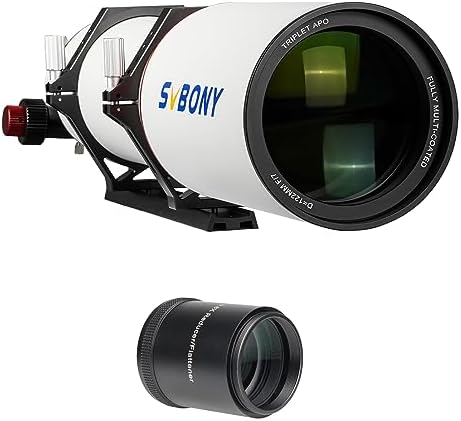
This SVBONY SV550 bundle features a compact 122mm aperture that gathers more light for clearer deep-sky images. The included SV211 dovetail base provides convenient handling and guide scope installation for astrophotography.
We may earn a commission when you buy through this link, at no additional cost to you.
The FPL-51 triplet apochromatic lens structure contains one piece of ED glass to greatly reduce chromatic aberration. A comfortable carrying handle ensures easy transport when fitting into the included carrying case.
With a limiting magnitude suitable for fainter objects, this scope offers detailed imaging performance. The 203mm dovetail base uses standard M6 and M4 screws for secure and easy removal.
Ideal for travelers needing high resolution, this bundle balances aperture and portability. Its design simplifies setup while delivering professional-grade optical quality for both observation and imaging.
The 122mm aperture allows you to capture fainter deep-sky objects with greater detail and clarity.
A portable handle attached to the dovetail base makes carrying and moving the large-aperture telescope effortless.
We may earn a commission when you buy through this link, at no additional cost to you.
This SVBONY SV550 kit includes the SV209 0.8X focal reducer field flattener designed specifically for prime focus astrophotography. The reducer corrects field curvature while providing a wider field for efficient shooting.
We may earn a commission when you buy through this link, at no additional cost to you.
The 122mm FPL-51 triplet apochromatic lens structure ensures minimal aberrations and enhanced sharpness across the frame. Internal extinction measures and lightweight construction maintain high contrast for deep-sky targets.
While it requires specific alignment, the integrated reducer improves edge-of-field quality significantly. This makes it suitable for larger sensors and wide-field deep-sky targets requiring precise optical correction.
Ideal for advanced photographers seeking wide-field performance, this bundle offers professional features. Its design simplifies achieving sharp images at the edges of the frame for stunning results.
The 0.8X reducer widens the field of view while correcting field curvature for broader imaging.
SV209 flattener improves imaging quality and shooting efficiency at the edges of your target.
We may earn a commission when you buy through this link, at no additional cost to you.
This SVBONY SV550 122mm triplet APO telescope kit includes all essential accessories for prime focus astrophotography. The 0.8X focal reducer field flattener corrects curvature and widens the field effectively.
We may earn a commission when you buy through this link, at no additional cost to you.
The included SV211 dovetail base with portable handle ensures convenient carrying and moving of the large-aperture telescope. Internal extinction measures reduce stray light for high contrast deep-sky images.
With a high limiting magnitude, this kit captures fainter objects that smaller scopes miss. The 122mm aperture gathers sufficient light for detailed planetary and deep-sky observation.
Perfect for photographers seeking a ready-to-go package, this bundle eliminates accessory hunting. Its design ensures optimal optical performance and ease of use for both beginners and pros.
This kit includes the focal reducer and dovetail base, providing everything needed for immediate imaging.
The comfortable handle on the dovetail base makes lifting and transporting the large telescope simple.
We may earn a commission when you buy through this link, at no additional cost to you.
This SVBONY SV550 80 triplet APO telescope kit includes the SV209 field flattener to correct fringe field curvature. The triplet apochromatic optics structure uses S-FPL51 ED glass to improve blue-edge aberration.
We may earn a commission when you buy through this link, at no additional cost to you.
Ultra wide band fully multilayer coated lenses and double glass optics ensure bright, clear images with minimal reflections. The comfortable carrying handle improves safety during product installation and transport.
With a simple difficulty factor, this kit is accessible for beginners seeking quality imaging. It reveals wonders of celestial bodies like the Messier catalog targets easily.
Ideal for casual observers starting astrophotography, this bundle balances cost and performance. Its design ensures clarity and portability for exploring galaxies and deep-sky objects effectively.
The included SV209 flattener corrects field curvature to improve image quality at the field edges.
Ultra wide band coatings on the triplet lens reduce reflections for sharper and clearer views.
We may earn a commission when you buy through this link, at no additional cost to you.
This SVBONY SV550 122mm APO telescope kit includes the SV165 mini guide scope and SV905C telescope camera for complete imaging. The compact camera features 1.23-megapixel and high peak QE for tight tracking.
We may earn a commission when you buy through this link, at no additional cost to you.
The 122mm FPL-51 triplet apochromatic lens structure ensures minimal chromatic aberration and sharp deep-sky images. The included SV211 dovetail base provides convenient handling for the telescope.
Compatible with mainstream auto-guiding cameras, the setup supports precise tracking. The guide scope bracket allows easy installation and removal for flexible imaging configurations.
Ideal for astrophotographers needing guided accuracy, this package simplifies setup. Its design ensures high sensitivity and clarity for capturing faint deep-sky objects effectively.
The included mini guide scope and camera ensure precise autoguiding for sharp long-exposure images.
SV905C camera features high peak QE and low read noise for tight tracking of faint guide stars.
We may earn a commission when you buy through this link, at no additional cost to you.
Selecting the right apochromatic refractor involves balancing optical quality, aperture size, portability, and budget. This guide outlines key factors to consider for optimal performance.
Aperture determines light-gathering power and resolution. Larger apertures like 122mm reveal fainter deep-sky objects but add weight. For portable setups, 80mm offers a balance between detail and transportability.
Choose aperture based on your primary targets and mount capacity for best results.
Triplet and quadruplet air-spaced designs provide better color correction than doublets. Look for S-FPL51 or FCD1 HOYA glass for minimal chromatic aberration across the field.
Prioritize air-spaced triplets for astrophotography to ensure sharp stars without fringing.
Focal ratios around f/6 to f/7 offer versatility for both visual and imaging use. Faster ratios like f/6 capture more light per exposure while maintaining manageable tube length.
Select f/6 for broader deep-sky imaging or f/7 for more detailed planetary views.
Ensure the dovetail plate matches your mount system, typically Vixen or Losmandy. A stable mount is essential for long-exposure astrophotography to prevent tracking errors.
Check accessory options and handle designs to ensure seamless mounting and portability.
Bundles with field flatteners and focal reducers simplify astrophotography setup. Consider whether you prefer ready-to-use kits or modular components for flexibility.
Opt for complete kits if you seek immediate imaging performance without extra purchases.
Lightweight materials like magnesium alloy focusers reduce overall telescope weight. Look for carrying handles and compact dew shields for easy transport to dark sites.
Prioritize portability if you plan spontaneous stargazing or travel imaging sessions.
Prices vary from entry-level ED scopes to premium air-spaced triplets. Evaluate features versus cost to find the best value for your specific needs.
Set a budget limit and focus on optical performance within that range.
Brands with USA-based customer support offer reliable warranty service and guidance. Check reviews for build quality and responsiveness when encountering issues.
Choose reputable brands with strong service networks for long-term satisfaction.
Align your telescope mount carefully before each session. Use the included finder scope to locate bright stars and calibrate the guide system for accurate tracking.
Allow the optics to acclimatize to ambient temperatures before imaging. This reduces thermal currents inside the tube that degrade star sharpness.
Clean lenses gently using air blowers and soft microfiber cloths. Store the telescope in a dry case with silica gel to prevent dew and dust accumulation.
An apochromatic refractor uses special low-dispersion glass to correct chromatic aberration, producing sharp color-free images. Unlike achromatic scopes, APOs eliminate blue fringing for clearer views of stars and deep-sky objects.
Triplet designs use three lens elements to correct three wavelengths of light, ensuring better color accuracy. This results in sharper star images without the false color seen in doublet refractors.
For astrophotography, especially with larger sensors, a field flattener is essential. It corrects field curvature ensuring stars remain sharp across the entire image sensor.
An 80mm aperture is ideal for beginners. It offers excellent light gathering and portability while keeping the telescope lightweight and easy to mount on standard tripods.
Yes, apochromatic refractors deliver high contrast and sharp detail ideal for planetary observation. The lack of chromatic aberration ensures clear views of lunar and planetary surfaces.
APO refractors generally require minimal collimation. Check alignment periodically if impacts occur or stars appear distorted, adjusting using the front cell screws as needed.
Our top picks include the SVBONY SV550 AP0 for overall balance, the SVBONY SV503 for budget aperture, and the Askar 71F for portable premium imaging.
Prioritize optical quality and accessories that match your imaging goals. Whether you seek sharp visuals or detailed astrophotography, these models deliver professional performance.
Always verify current availability and accessories before purchase to ensure you get the right setup for your astronomy journey.