
FNIRSI HRM-10
4.4Editor score
Automatic Voltage Resistance Test
TFT HD Color Display
Wide Application Range
This guide compares the top Battery Internal Resistance Tester models for accuracy and ease of use across automotive and hobbyist applications.
Choosing the right Battery Internal Resistance Tester is essential for diagnosing battery health accurately. These devices measure internal resistance to detect degradation before failure occurs.
We compared ten top-rated testers based on precision, features, and usability. Each model offers unique capabilities for professionals and enthusiasts alike.
Each pick highlights key strengths and ideal use cases. Prices fluctuate frequently so verify current offers before purchasing your preferred model today.
4.4Editor score

4.5Editor score

4.9Editor score
The following table provides a side-by-side comparison of all ten models including key specifications and performance metrics for informed decision-making.




The ZOYI ZT-XR1 combines a multimeter and battery resistance tester in one powerful unit. It holds a strong 4.5-star rating for its accuracy and versatility.
We may earn a commission when you buy through this link, at no additional cost to you.
This device supports 25000 counts with true RMS measurement and dedicated 4-wire Kelvin sensing. Its rechargeable battery lasts up to 10 hours on single charge.
Trade-offs include a steeper learning curve and higher cost compared to single-function tools. These are acceptable given its broad professional utility.
Electricians and serious hobbyists should buy this for comprehensive diagnostics. It is the top recommendation for precision and functionality combined.
Combining multimeter and resistance tester reduces equipment needs and saves cost.
True RMS and 4-wire testing ensure reliable readings even in complex circuits.
We may earn a commission when you buy through this link, at no additional cost to you.
The FNIRSI HRM-10 is an accessible option for entry-level users seeking accurate resistance testing. It carries a 4.4 rating for reliable performance at a low cost.
We may earn a commission when you buy through this link, at no additional cost to you.
Features include automatic resistance and voltage measurement with a clear color TFT display. Users can export historical data via USB for deeper analysis.
While build quality is standard for the price, the core functions remain solid. This makes it ideal for casual testers not needing premium durability.
Budget-conscious buyers should choose this for essential diagnostics. It balances affordability with the accuracy needed for most household and automotive tasks.
Automatic testing modes and clear display simplify operation for non-experts.
Exporting test records allows tracking battery health trends over time.
We may earn a commission when you buy through this link, at no additional cost to you.
The RC3563 stands out with a near-perfect 4.9-star rating for its precision and specialized battery testing focus. It uses Kalman filtering for stable measurements.
We may earn a commission when you buy through this link, at no additional cost to you.
Its Kelvin clamp system ensures minimal contact resistance which is crucial for low-ohm measurements. The device is lightweight and supported by a reliable lithium battery.
Manual configuration may deter some users but enhances control over test parameters. The lack of multimeter functions keeps it focused on core resistance tasks.
Experts and lab professionals should select this for highest accuracy. It excels in scenarios where measurement integrity outweighs convenience features.
Kalman filtering improves stability during fluctuating resistance measurements.
Handheld design allows testing across work sites without heavy equipment.
We may earn a commission when you buy through this link, at no additional cost to you.
The Dlyfull tester is ideal for general consumers needing quick checks on household batteries. It holds a 4.4 rating and supports 11 different battery types.
We may earn a commission when you buy through this link, at no additional cost to you.
A rotary dial allows users to select voltage settings easily while testing. It displays capacity percentages to help decide if a battery needs replacement.
It lacks advanced resistance ranges for specialized electronics but suffices for daily use. Build quality ensures durability for occasional home diagnostics.
Households with mixed batteries should buy this for convenience. It simplifies battery management without technical complexity or high costs.
Support for 11 types covers most consumer electronics and toys.
Rotary selection ensures quick setup without needing menus.
We may earn a commission when you buy through this link, at no additional cost to you.
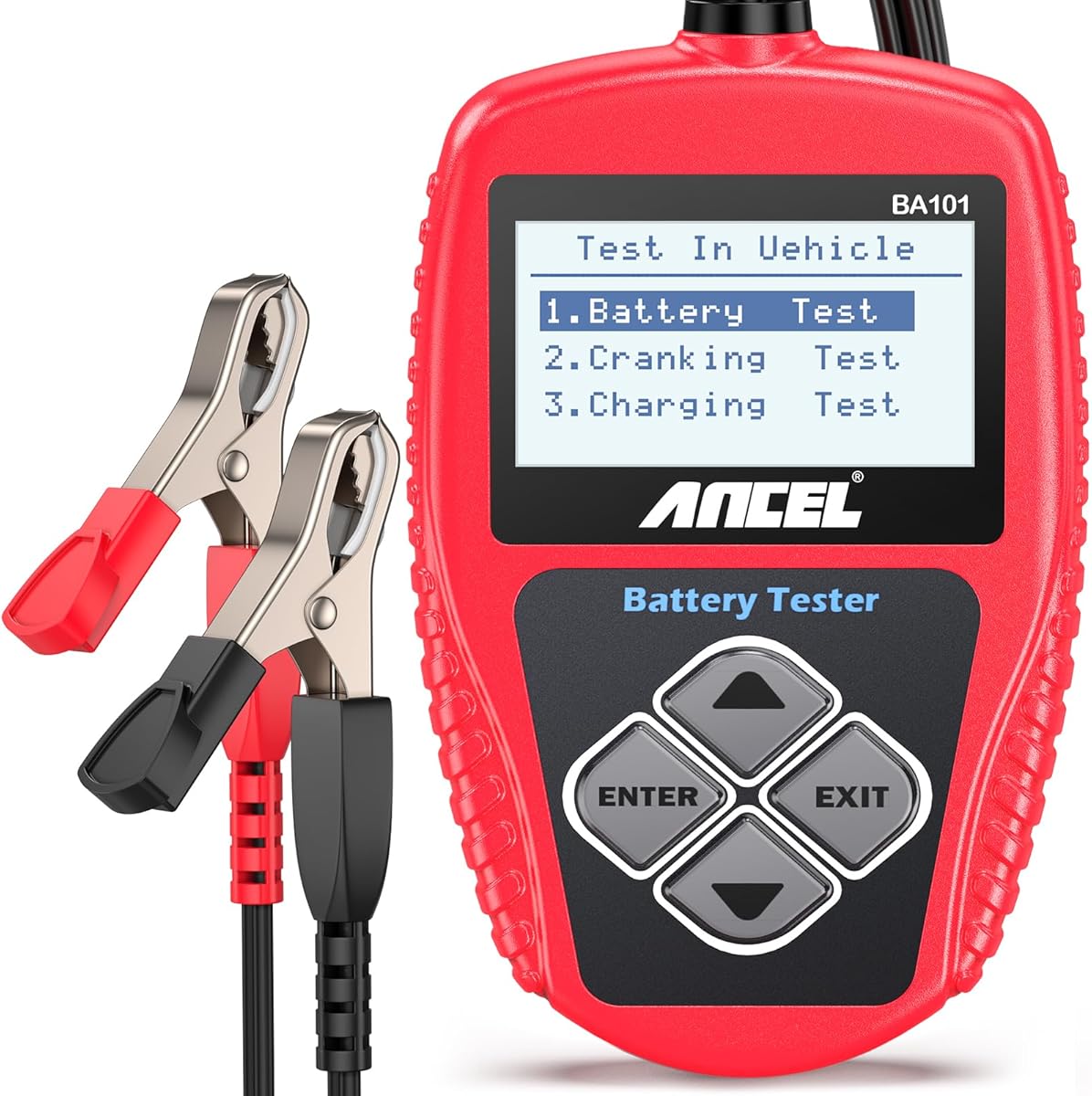
The ANCEL BA101 is specifically engineered for 12V automotive batteries and alternator diagnostics. It has earned a 4.5 rating for reliability in vehicle testing.
We may earn a commission when you buy through this link, at no additional cost to you.
It offers detailed State of Health and Charge readings to predict battery failure. Direct power from the vehicle battery eliminates need for internal cells.
Limitations include lack of lithium battery testing and fixed 12V range. However, these trade-offs ensure optimized accuracy for automotive applications.
Car owners and mechanics should choose this for vehicle health checks. It delivers critical diagnostics quickly and clearly for safe road readiness.
Tailored for automotive needs with CCA and charging system tests.
Integrated protection guards against polarity and voltage errors.
We may earn a commission when you buy through this link, at no additional cost to you.
The ZOYI XR1 offers hybrid functionality for multimeter and resistance testing tasks. It holds a 3.9 rating but provides extensive features for field work.
We may earn a commission when you buy through this link, at no additional cost to you.
It supports Kelvin clip testing with adjustable resistance ranges and a clear TFT screen. Type-C charging ensures easy power management during extended use.
Users may find setup slightly complex and ratings lower than premium models. Still, it delivers solid performance for general maintenance and repair.
Technicians seeking versatile tools should consider this model. It balances cost and utility effectively for varied diagnostic scenarios.
Type-C interface aligns with modern portable device power standards.
Robust housing resists drops and damage in workshop environments.
We may earn a commission when you buy through this link, at no additional cost to you.
The YR1035+ holds a perfect 5.0 rating for its precision four-wire measurement system. It is widely used for screening and configuration tasks.
We may earn a commission when you buy through this link, at no additional cost to you.
Its LCD shows real-time voltage and resistance clearly which helps in quick decision making. The unit is compact and portable for bench or field use.
Users should note it lacks some advanced connectivity features found in pricier units. This simplicity contributes to its high satisfaction score though.
Researchers and field technicians should pick this for reliable results. It ensures accurate diagnostics without unnecessary complexity in operation.
Four-wire configuration eliminates lead resistance errors for critical tests.
LCD screen provides clear readouts for rapid data interpretation.
We may earn a commission when you buy through this link, at no additional cost to you.
The T-685 provides specialized high-precision testing for lithium battery packs and supercapacitors. It has a low rating of 2.2 due to complexity.
We may earn a commission when you buy through this link, at no additional cost to you.
It measures AC and DC resistance with a wide range suitable for professional labs. USB connectivity allows data transfer for deeper analysis.
Its weight and interface may deter casual users. The advanced functions are beneficial for experts but less practical for simple checks.
Lab technicians working with lithium cells should consider this model. It delivers high precision where accuracy is critical for battery performance.
Capable of measuring supercapacitor ESR under low current conditions.
USB port enables connection to computers for record keeping.
We may earn a commission when you buy through this link, at no additional cost to you.
This accessory kit expands capabilities of YR1035+ testers for specialized battery forms. It holds a 5.0 rating for high utility and quality construction.
We may earn a commission when you buy through this link, at no additional cost to you.
It includes clamps and adapters for various electrodes such as lugs and buttons. Type-C charging adds modern convenience to the existing hardware.
Users must already own the main tester so this is an upgrade not a standalone. It enhances versatility for niche battery types.
Owners of YR1035+ should purchase this for expanded testing. It ensures accurate contacts for batteries that standard probes might miss.
Clamps accommodate electrodes that typical probes cannot reach securely.
Type-C port supports universal chargers for quick recharging.
We may earn a commission when you buy through this link, at no additional cost to you.
The WESTOBIG tester features an upgraded Kelvin four-terminal sensing and automatic mode gears for ease of use. It has a 4.3 rating for professional features.
We may earn a commission when you buy through this link, at no additional cost to you.
Users can preset up to eight data sets to quickly identify out-of-spec batteries. Data transfers to PC via Excel for detailed analysis.
The menu system may require time to master fully. However, the presets and automation save time during bulk battery testing.
Facilities managing large battery inventories should choose this model. Its automation and data capabilities streamline quality control significantly.
Automatic modes reduce manual setup steps for faster testing.
PC transfer enables detailed tracking and reporting of results.
We may earn a commission when you buy through this link, at no additional cost to you.
Selecting the right tester requires balancing accuracy and budget with your specific battery types and testing needs.
Accuracy depends on the testing method and circuit design. True 4-wire Kelvin connections remove lead resistance to improve low-ohm precision.
Prioritize testers with 4-wire systems for reliable battery health diagnostics.
Ensure the tester supports your specific battery chemistries such as lead-acid lithium ion or NiMH. Voltage and resistance ranges must cover your use case.
Check compatibility charts to avoid purchasing tools that cannot test your batteries.
Clear displays help users read data quickly in varied lighting conditions. TFT or high-resolution LCD screens improve usability especially when wearing gloves.
Select models with adjustable brightness to reduce eye strain during extended use.
Features like memory, export functions, or software connectivity allow long-term tracking. These tools are valuable for maintenance schedules and quality control.
Choose units with data export options if you need detailed historical records.
Built-in rechargeable batteries offer convenience but limit runtime. Units powered directly from the tested device avoid charging needs entirely.
Consider battery life and charging options to match your workflow demands.
Build materials like ABS housing and safety ratings protect both user and equipment. Overcurrent and reverse polarity protection are critical for automotive use.
Ensure the tester meets safety ratings relevant to your environment like CAT III.
User interfaces with auto mode or rotary dials reduce setup time. Complex menus may hinder efficiency for quick field tests.
Look for intuitive controls if testing frequency is high or users are less technical.
Higher price often reflects better sensors and build quality but budget models suffice for basic checks. Warranties should match the expected use period and stress.
Compare warranty length and terms when choosing between similarly priced options.
First prepare the device by ensuring it is fully charged and calibrated. Inspect the probes and cables for wear or damage before connecting to any battery terminals.
Connect the tester using the proper terminals or clamp leads. Follow the device instructions to select voltage ranges or modes for your specific battery type.
After testing disconnect the probes carefully and store the unit in a dry place. Avoid exposing the device to extreme temperatures or moisture to preserve its lifespan.
Internal resistance indicates how easily current flows within a battery. High resistance signals degradation or aging which may cause sudden failure under load. Testing it helps predict battery replacement timing before issues arise.
For critical applications like automotive or emergency gear test batteries every three to six months. Regular household items can be checked once a year. Frequent testing ensures safety and prevents unexpected loss of power.
Many testers support lithium batteries but check the voltage range limits carefully. Specialized models exist for lithium packs. Always use probes rated for lithium to ensure safe and accurate measurements.
Most internal resistance testers estimate capacity based on resistance values. For direct capacity measurement you need a charger-discharger unit. Resistance testing is faster for health checks.
The 4-wire method uses separate pairs for current and voltage to eliminate lead resistance errors. This is essential for measuring low ohms accurately in small batteries. It ensures readings reflect the battery only.
Most digital units self-calibrate at startup or through menu settings. Follow manufacturer instructions for zeroing. Regular calibration with known resistors maintains accuracy over time.
This guide presented ten top-rated Battery Internal Resistance Testers for different needs. The ZOYI ZT-XR1 leads overall while the FNIRSI HRM-10 offers best budget value.
Prioritize features like 4-wire sensing and data tracking if precision matters. For general use simpler units deliver sufficient accuracy at lower prices.
Always verify current prices and availability before purchasing. Battery technology evolves and model updates may change what is best today.