
AURSINC ZK09‑UM LNA Module
4.9Editor score
USB powered operation
100kHz to 10GHz range
21dB gain
This guide compares top ham radio amplifier options for boosting signal strength across various frequency bands and use cases for operators.
Ham radio enthusiasts often face challenges with weak signals over long distances. Choosing the right amplifier can significantly improve communication clarity and range for both casual listeners and serious operators looking to enhance their station performance.
We evaluated ten top-rated models based on gain performance, frequency coverage, power requirements, and reliability. This list includes low noise amplifiers for reception and linear amplifiers for transmission to cover diverse operational needs in the hobby.
Each pick highlights specific strengths like portability or high power output. Please note that product availability and pricing change frequently so check current listings before making your final purchase decision for your specific setup.
4.9Editor score

4.2Editor score

4.2Editor score
The following table provides a side-by-side comparison of key specifications for all ten selected products to help you quickly identify the model that best fits your specific operating requirements and budget constraints.




This low noise amplifier offers an impressive frequency range from 0.1MHz to 2000MHz making it suitable for a wide array of radio applications. With a rating of 4.2 stars it stands out as a reliable choice for boosting weak signals in amateur radio setups.
We may earn a commission when you buy through this link, at no additional cost to you.
The 32dB gain significantly enhances reception quality for distant stations without introducing excessive noise. Its low noise figure ensures that the signal to noise ratio remains optimal even in challenging environments where signal degradation is a concern.
Users should note that while the amplifier is efficient it requires careful handling to avoid overloading sensitive receivers. Proper impedance matching at 50 ohm is critical to maintain performance and prevent signal reflection issues during operation.
This model is ideal for operators seeking a versatile solution that works across multiple bands. It is particularly beneficial for those involved in shortwave listening or SDR projects who need consistent performance without complex configuration steps.
The low noise design ensures that faint signals are amplified without adding background hiss which is crucial for clear communication on crowded bands.
Works seamlessly with CB radios SDR units and ham transceivers providing a unified solution for various radio hobbyist needs.
We may earn a commission when you buy through this link, at no additional cost to you.
The Xiegu GPA100 delivers clean and stable RF output suitable for serious HF operations. Its solid-state linear design ensures low distortion and high efficiency which is essential for maintaining signal purity during extended transmissions on various modes.
We may earn a commission when you buy through this link, at no additional cost to you.
Flexibility is a key strength with manual buttons or auto mode for band switching. This feature simplifies operation for users who frequently move between modes like SSB CW and digital without needing to manually adjust settings constantly.
Protection features including high SWR and overheat detection add a layer of safety for the unit. Users should be aware that while it offers BT control compatibility depends on specific radio models like the IC-705 for full wireless functionality.
This amplifier is best for operators looking to expand a QRP setup into a robust 100W station. The intelligent control system ensures safe operation making it a reliable choice for daily use in demanding radio environments.
Delivering up to 100W on HF bands allows operators to reach distant stations with greater ease and reliability compared to low power setups.
Built-in protection against overcurrent and overheating prolongs the lifespan of the amplifier while ensuring safe operation during long sessions.
We may earn a commission when you buy through this link, at no additional cost to you.
This module stands out with a perfect rating and a wide range from 10MHz to 6GHz. It is designed for diverse tasks including FM broadcasting SDR monitoring and ham radio making it a versatile tool for many users.
We may earn a commission when you buy through this link, at no additional cost to you.
With 30dB gain and a noise figure of 5dB it effectively strengthens weak signals while maintaining clear reception. The P1dB rating at 10dBm ensures dependable signal handling across a broad working frequency span for reliable operation.
The Type C 5V power supply makes it easy to integrate into compact setups without needing specialized power adapters. Users should keep in mind the 50 ohm impedance requires proper cabling to avoid signal loss in the system.
Ideal for hobbyists needing a front-end boost for their receivers this unit offers excellent performance at a low cost. Its lightweight design fits neatly into portable rigs or fixed installations for convenient use.
The high gain and low noise characteristics ensure that even faint signals are captured clearly improving overall listening experience.
Standard SMA connectors and Type C power allow for quick setup without complex wiring or additional accessories.
We may earn a commission when you buy through this link, at no additional cost to you.
This LNA is designed for portability with a built-in battery allowing up to 5 hours of continuous operation. It enhances weak signal detection across an ultra-broadband range making it perfect for outdoor antenna tuning and field testing.
We may earn a commission when you buy through this link, at no additional cost to you.
The miniature metal housing provides solid shielding against interference ensuring stable performance in both laboratory and field environments. It is compact enough to fit in a toolkit or pocket making it a convenient companion for DXing.
Users must avoid using it in overly noisy environments to prevent AGC compression and distortion. It is advisable not to use it simultaneously with the TinySA's built-in LNA for optimal spectral purity and accurate readings.
Best for operators who need a trustworthy RF signal booster on the go this kit includes everything needed for setup. While handling requires care its ability to make faint distant signals visible is a significant advantage for testing.
The integrated battery eliminates the need for external power banks allowing uninterrupted use during remote field operations.
The flat gain profile across frequencies ensures consistent amplification which is vital for accurate signal analysis on spectrum analyzers.
We may earn a commission when you buy through this link, at no additional cost to you.
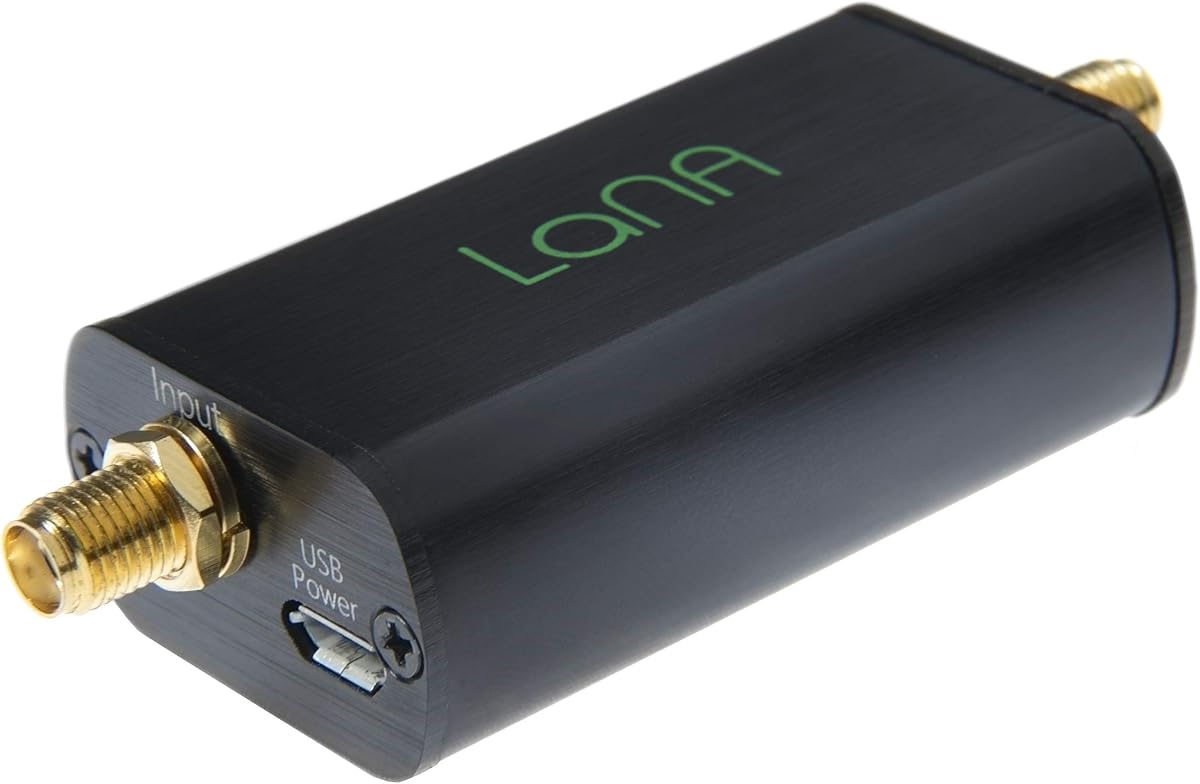
The Nooelec Lana is a high-performance LNA module designed to improve the SNR of SDRs and other radios. It offers wideband capability from 20MHz to 4000MHz making it suitable for a variety of radio applications and frequencies.
We may earn a commission when you buy through this link, at no additional cost to you.
Compared to modules based on SPF5189Z it offers higher gain and lower power consumption. The installation in a quality aluminum enclosure ensures durability and protects the internal components from environmental factors during use.
Users can power it through bias tee USB or DC power with the included adapter. However note that some SDRs may require a DC block between the LNA and SDR if utilizing external power options to prevent interference.
This module is ideal for SDR enthusiasts looking to enhance their receiver performance. Its superior linearity and efficiency make it a reliable upgrade for those seeking clearer signals and better overall radio performance.
The ultra low noise figure minimizes added noise allowing for clearer reception of weak signals in high-interference areas.
Multiple power options allow users to integrate the LNA seamlessly into different power setups without extra complexity.
We may earn a commission when you buy through this link, at no additional cost to you.
This wideband scanner pre-amplifier covers a frequency range from 25 to 2000 MHz which is suitable for many scanner applications. It features a gain range of 6 to 20dB making it a practical choice for boosting signals without overwhelming the receiver.
We may earn a commission when you buy through this link, at no additional cost to you.
Powered by a PP3 battery it is portable and easy to use without needing an external power supply. The package includes a BNC patch lead allowing for quick connection to compatible receiver setups for immediate use.
Users looking for a simple solution to enhance scanner performance will find this unit convenient. The gain is sufficient for typical scenarios but may not be enough for extremely weak signal environments requiring higher amplification.
Best for hobbyists focused on scanner listening this amplifier offers reliability and simplicity. It is a cost-effective way to extend the reach of a scanner receiver in areas with weaker signal coverage.
Designed specifically for scanner receivers it ensures compatibility and optimized performance for monitoring various radio frequencies.
Battery operation allows for mobile use without the need for wall outlets making it ideal for on-the-go scanning activities.
We may earn a commission when you buy through this link, at no additional cost to you.
This amplifier supports multiple modulation modes including AM FM SSB and CW with high output power levels. It is designed to extend communication range for reliable long-distance operation in CB and ham radio setups.
We may earn a commission when you buy through this link, at no additional cost to you.
The built-in high-efficiency cooling fan and large aluminum heat sink ensure stable operation during extended use. These thermal management features prevent overheating and protect internal components from damage due to prolonged transmission.
Safety features include electronic polarity reversal protection and dual 15A fuses to safeguard against incorrect power connections. The user-friendly design with simple controls and standard connectors makes installation quick and straightforward for all users.
Ideal for users needing robust output for long-distance communication this unit handles various modes effectively. Proper ventilation and setup are essential to maintain performance and ensure the cooling system functions correctly.
The active cooling system allows for sustained transmission without risking component damage which is crucial for high-power operation.
Support for AM FM SSB and CW makes this amplifier adaptable to different communication needs across various radio bands.
We may earn a commission when you buy through this link, at no additional cost to you.
This ultra-broadband LNA module operates from 100kHz to 10GHz with a gain of 21.5dB at 10MHz. It is ideal for TinySA ULTRA and similar devices providing high-frequency test performance where onboard LNAs fall short.
We may earn a commission when you buy through this link, at no additional cost to you.
Powered via USB it offers convenient power supply without external adapters. The built-in high PSRR LDO suppresses power supply noise significantly improving the noise floor compared to regular USB powered modules available on the market.
The compact shielded metal housing protects against interference but requires dry conditions to prevent rust. Users should avoid applying excessive input power to prevent saturation or permanent damage to the internal components.
Perfect for testing and reception tasks this module offers excellent flatness and low noise. It is a reliable choice for engineers and hobbyists needing an external preamplifier for high-band receiving and measurement.
The onboard LDO ensures minimal noise introduction which is critical for sensitive measurement and reception applications.
Covering from kHz to GHz range it supports a vast array of frequencies making it versatile for many test setups.
We may earn a commission when you buy through this link, at no additional cost to you.
This amplifier delivers up to 150W SSB output power supporting multiple modes for versatile use. It is designed to work with HF transceivers requiring low input power extending communication range for reliable operation.
We may earn a commission when you buy through this link, at no additional cost to you.
Safety features include electronic polarity reversal protection and dual 15A fuses to guard against electrical surges. The cooling fan and heat sink ensure stable operation during extended use by preventing overheating of internal components.
Controls are simple with switches for power and mode selection making it easy to use. Standard PL-259 connectors allow for quick installation and setup for both new and experienced users in radio stations.
Best for operators needing a straightforward high-power solution this unit offers dependability. While the fan adds some noise the effective thermal management ensures longevity and consistent performance over time.
Integrated protection features prevent damage from incorrect connections or power surges ensuring safe daily operation.
The combination of fan and heat sink maintains optimal operating temperatures for long transmission sessions.
We may earn a commission when you buy through this link, at no additional cost to you.
This linear amplifier delivers up to 150W SSB output power making it suitable for radio and ham radio applications. It features dual power control switches allowing users to adjust output strength based on operating needs efficiently.
We may earn a commission when you buy through this link, at no additional cost to you.
Enhanced protection includes electronic switch and polarity inversion protection to safeguard from incorrect power connections. The compact aluminum alloy heat sink construction ensures efficient heat dissipation during operation in various environments.
Installation is straightforward with standard antenna and transceiver ports. The HI/LO power selection helps manage heat and power consumption based on the specific communication requirements of the user.
Practical for those needing a robust amplifier this unit offers high output with safety features. The design supports reliable signal amplification for HF transceiver applications across the frequency range.
HI and LO power switches give users flexibility to optimize performance and heat management for different situations.
Protection features ensure that accidental incorrect wiring does not damage the amplifier or connected equipment.
We may earn a commission when you buy through this link, at no additional cost to you.
Selecting the right amplifier depends on your specific operational needs including frequency range power requirements and intended use cases.
Ensure the amplifier covers the bands you intend to use. Some units are designed for HF while others cover VHF UHF or broadband ranges up to several GHz.
Choose a model that matches your primary operating frequencies to avoid signal loss or inefficient amplification.
Higher gain helps boost weak signals but a low noise figure is crucial to maintain signal clarity. Look for balanced specifications for optimal performance.
A low noise figure ensures that the amplifier does not introduce excessive static or interference to your received signals.
Check the power supply needs such as voltage and current. Some models run on USB or batteries while others require dedicated power supplies.
Select a power option that fits your operating environment whether portable field use or fixed station setup.
Verify the maximum input and output power ratings to match your transceiver capabilities. Exceeding ratings can cause damage to both the amplifier and radio.
Ensure the amplifier can handle the power levels you plan to transmit without distortion or overheating.
Confirm that the connectors match your cables and equipment such as SMA BNC or PL-259. Mismatched connectors may require additional adapters.
Standard connectors simplify setup and ensure reliable connections without unnecessary signal loss or complexity.
Look for features like polarity protection thermal management and SWR protection. These safeguard the amplifier from common electrical issues.
Protection features extend the lifespan of the device and ensure safe operation during long transmission sessions.
Consider the size and weight if you plan to use the amplifier in the field. Compact and lightweight models are easier to transport and set up.
Portable designs often include battery options or small enclosures that fit into tight spaces or mobile rigs.
Check that the amplifier is compatible with your specific radio model and modes such as SSB or FM. Some units offer specific optimizations for certain transceivers.
Compatibility ensures seamless integration and reliable performance without requiring complex configuration steps or extra hardware.
Always match the impedance to 50 ohm and use quality cables to minimize signal loss during transmission and reception.
Ensure proper ventilation and cooling especially for high power linear amplifiers to prevent overheating and component damage over time.
Regularly inspect connectors and power supplies for wear and tear to maintain optimal performance and safety during operation.
Low Noise Amplifiers (LNA) are designed for receiving signals and focus on improving signal to noise ratio without adding noise. Linear amplifiers boost transmitted signals for higher output power and are used to extend communication range. Choose based on whether you need better reception or stronger transmission.
Some amplifiers run on USB or batteries for portability while others require external power supplies like 12V DC units. Check the specifications of your chosen model to determine power requirements and plan accordingly for your setup.
Amplifiers are optimized for specific frequency ranges so using them outside that range can result in poor performance or signal loss. Ensure the model covers your operating bands to maintain clarity and effective amplification.
Most amplifiers are designed to work with standard radios but compatibility depends on connectors and input power levels. Verify that your radio supports the input requirements and connector types of the amplifier before purchasing.
Always use protection features like polarity reversal safeguards and ensure adequate cooling to prevent overheating. Check connections before powering up to avoid electrical surges or short circuits that could damage equipment.
Keep connectors clean and free from corrosion and inspect cables for any signs of wear. Store in a dry environment and avoid exposing the unit to extreme temperatures to preserve its lifespan and performance.
LNAs are mainly for receiving while linear amplifiers are for transmitting. Some units may support both but verify the product specifications to ensure it meets your needs for either receive or transmit operations.
Turn off the unit immediately and allow it to cool down before restarting. Ensure the cooling fan is unobstructed and the unit has adequate airflow to prevent repeated overheating during use.
This guide reviewed ten top models ranging from budget LNAs to powerful linear amplifiers suitable for various radio applications and user preferences.
Prioritize frequency range gain and power requirements when selecting an amplifier to ensure it meets your specific communication needs effectively.
Always check current availability and specifications before purchasing to confirm the model aligns with your station setup and operational goals.